
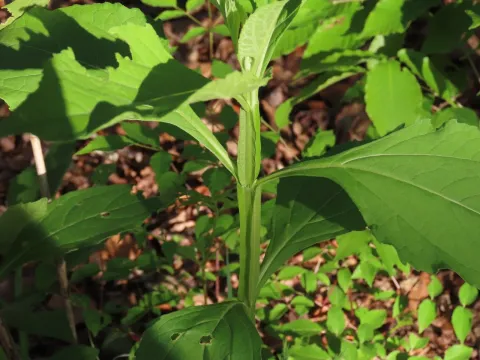
White crownbeard
Verbesina occidentalis
White crownbeard (Verbesina occidentalis) is a perennial member of the Asteraceae family, recognized for its robust growth and ecological versatility. It serves as an excellent candidate for landscape restoration and biomass production in temperate regions.
What the section contains
White crownbeard
Seed sowing is typically performed in early spring once soil temperatures reach 12–15 degrees Celsius. Pre-chilling or stratification of seeds for several weeks significantly enhances germination rates and ensures more uniform establishment across the field.
The seeds should be sown at a shallow depth of 1–2 centimeters, ensuring sufficient contact with moist soil. A light roller pass after sowing helps to secure seeds and improves capillary water absorption, which is vital for the germination of small seeds.
During the first growing season, the plant allocates most of its energy to root development and forming a basal rosette. Successful stand establishment depends on maintaining a weed-free environment during this slow initial phase of growth.
Site selection should prioritize areas with full sun exposure to semi-shade. Although the plant is adaptable, optimal vertical growth and flower production occur in sites where competition from dominant grasses is minimized during the first year.
Verbesina occidentalis thrives in a variety of soil types, including sandy loams and clay-heavy soils. The species prefers well-drained conditions but demonstrates a remarkable tolerance for periodic soil moisture, making it resilient in varying weather patterns.
The plant is known for its moderate drought resistance, attributed to its deep, vigorous root system. This allows the plant to access sub-surface water reserves, maintaining growth even during short dry spells when other vegetation might wilt.
Temperature requirements are consistent with native temperate flora, with ideal growth occurring between 20–28 degrees Celsius. While it can withstand freezing winter temperatures, the above-ground biomass naturally senesces, and the plant overwinters via its root crown.
In terms of soil nutrition, it is not particularly demanding. However, supplemental nitrogen application in early spring can boost vegetative biomass production, which is a critical metric for producers interested in using the plant as a technical crop.
Cultural management includes regular inter-row cultivation during the establishment phase. Once the plant achieves canopy closure, it effectively outcompetes most invasive weeds, reducing the need for chemical herbicide intervention.
The harvestable biomass of white crownbeard can be quite substantial, with mature stands often yielding 5 to 8 tons of dry matter per hectare annually. Yield consistency is dependent on maintaining healthy plant density after the first year of growth.
Timing the harvest is crucial to maximize nutrient content. Harvesting at the early bud stage ensures the highest quality material. Delaying the harvest leads to lignification of the stems, which decreases overall digestibility and quality for secondary uses.
The species exhibits strong regenerative capabilities, often allowing for a secondary harvest if late-summer rainfall is sufficient. However, producers should monitor soil moisture levels to ensure the plant has enough energy for winter survival after consecutive cuttings.
The high cellulose content in the mature stalks makes this species a potential feedstock for biofuel research. Studies suggest that managing plant architecture through specific planting densities can further enhance structural biomass yields.
Pollinator support is a secondary but significant yield benefit. As a late-season bloomer, Verbesina occidentalis provides essential nectar resources, which can increase the overall ecosystem services provided by the agricultural land.
White crownbeard is remarkably hardy and resistant to many standard agricultural pathogens. Its natural secondary metabolites act as a deterrent to many foliage-feeding insects, minimizing the need for conventional pesticide usage.
Root rot remains the primary concern in areas with inadequate drainage or persistent waterlogging. Selecting higher-elevation planting sites or installing proper tile drainage is the best proactive measure against fungal soil-borne diseases.
Insect pests are generally limited to minor infestations of aphids or specific lepidopteran larvae. In most cases, these do not reach economic injury levels and are kept in check by natural predator populations found in diverse fields.
- Aphids: Usually appearing on the tender shoot tips during the early summer.
- Flea beetles: Can cause minor cosmetic leaf damage during the vegetative stage.
- Root-knot nematodes: Might impact growth in sandy, heavily cropped soils after several years.
Integrated pest management strategies focusing on promoting beneficial insects are highly effective for this crop. Maintaining field edges with diverse flora supports these natural predators and keeps pest populations within sustainable limits.