
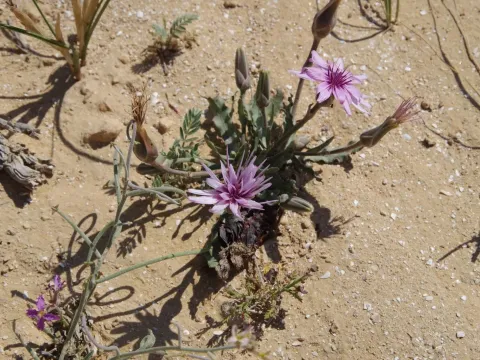
Tragopogon collinus
Tragopogon collinus
Tragopogon collinus, commonly known as a type of goat's beard, belongs to the Asteraceae family. This biennial herbaceous plant is increasingly studied for its potential in agricultural forage production and its adaptive qualities in dry environments.
What the section contains
Tragopogon collinus
The optimal sowing time is in early spring once the soil temperature consistently reaches 6–10 degrees Celsius. Early seeding is preferred to ensure that the plants establish a strong root system before the onset of summer heat.
Seeds should be sown at a depth of 1–2 centimeters in well-prepared, loose soil. A row spacing of 30–45 centimeters is recommended to reduce plant competition and allow for easier mechanical weed control between the rows during the first weeks.
Tragopogon collinus exhibits high germination energy under moist soil conditions. Once established, the seedlings are resilient and capable of rapid development, forming a rosette that protects the soil surface from erosion.
In regions with mild winters, late autumn sowing is possible to achieve earlier emergence in the following spring. This practice benefits from the natural moisture levels provided by winter precipitation.
This species is highly adapted to arid and semi-arid climates, thriving in open, sunny locations with well-drained soils. It is often found in the wild on rocky hillsides and stony slopes, which highlights its resilience to harsh environmental conditions.
The plant prefers sandy loam or loamy soils. It shows poor tolerance to waterlogging, thus site selection should prioritize areas with good natural drainage or moderate elevation to prevent root rot.
Tragopogon collinus is a heliophilic plant, requiring full sun exposure to maximize biomass production and the accumulation of beneficial compounds. Shading is strictly detrimental to the growth cycle and overall yield.
It displays remarkable tolerance to alkaline and carbonate-rich soils, where it can outperform many traditional forage crops. This makes it an ideal candidate for rehabilitating degraded or abandoned agricultural lands.
While the plant is hardy, it responds well to moderate nutrient management. Maintaining adequate phosphorus and potassium levels in the soil can enhance the plant's structural development and resilience against drought.
The forage yield of Tragopogon collinus depends significantly on water availability during the peak vegetative stage. Under managed conditions, the crop can produce 15–20 tons of green biomass per hectare per season.
Livestock, particularly small ruminants like sheep and goats, readily consume the plant due to its palatable foliage in the early development stages. It serves as a valuable source of protein and mineral components in pasture-based systems.
The taproot contains significant levels of inulin, a prebiotic fiber, which adds nutritional value. In some agricultural contexts, the plant is harvested not only for its leaves but also for its root biomass.
Seed yields range between 300 and 500 kilograms per hectare under optimal agrotechnical practices. Seed production requires attention to the crop's biennial nature, with the highest yield occurring in the second year.
Frequent cutting during the vegetative phase can stimulate lateral branching and regrowth, potentially allowing for multiple cuts per season if environmental conditions support sufficient moisture.
Tragopogon collinus is naturally resistant to many common fungal pathogens, which simplifies disease management significantly. It is generally less susceptible to rust and powdery mildew compared to other members of the Asteraceae family.
The most common pests affecting this crop include aphids, which may cluster on the tender tips of the plant during periods of extreme heat. Integrated pest management, focusing on field edges, is usually sufficient to control outbreaks.
Wireworms can pose a threat to the root system if the crop is planted in inadequately tilled or heavy soils. Proper deep plowing during fall preparation remains the most effective preventive measure.
Weed competition is only a serious threat during the initial seedling stage. Once the plants form a closed canopy, they are highly effective at suppressing competing weeds due to their rapid growth rate.
Care must be taken to ensure proper airflow in the field, as high humidity and density can encourage fungal growth at the base of the stems. Proper spacing is key to maintaining a healthy crop stand.
For high-quality forage, harvesting should occur during the early flowering phase. This timing ensures the best balance between protein content, digestibility, and total volume of biomass production.
Seed harvesting requires precision because the seeds are equipped with pappus, allowing them to disperse easily when ripe. Harvesting should begin immediately when the flower heads show signs of turning yellow.
Mechanical harvesting is typically performed using combined methods. Setting the threshing drum to low speeds is essential to prevent crushing the fragile seeds and preserving their viability for future planting.
Post-harvest cleaning involves removing excess plant material and pappus, followed by careful drying in a cool, ventilated area. Drying temperatures must be kept below 40 degrees Celsius to prevent damage to the embryos.
Proper storage in moisture-resistant containers is necessary to maintain seed viability for several years. Keeping seeds in a cool, dark location ensures they remain ready for the next sowing season.