
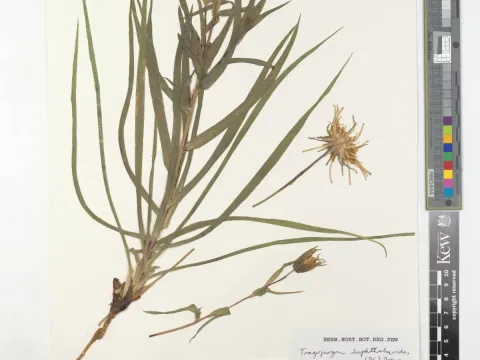
Tragopogon buphthalmoides
Tragopogon buphthalmoides
Tragopogon buphthalmoides is a perennial herb belonging to the Asteraceae family. Originating from the steppes of Central Asia, it has adapted to harsh environments characterized by limited rainfall and high solar radiation.
What the section contains
Tragopogon buphthalmoides
The plant thrives in well-drained, nutrient-rich soils, although it exhibits significant tolerance to poorer, alkaline substrates. Its deep taproot allows the plant to reach moisture reserves inaccessible to shallower-rooted crops.
Climate adaptability is one of its primary strengths, as the plant can withstand extreme temperature fluctuations and dry summer periods, making it a viable candidate for low-input agricultural systems.
Adequate sunlight is essential for development, as shading can lead to stunted growth and reduced metabolic efficiency during the critical flowering and seed-setting phases.
The morphological structure of the plant, including its resilient leaf tissues, minimizes water loss through transpiration, ensuring survival even during prolonged dry spells in its natural range.
Early spring is the recommended sowing period for Tragopogon buphthalmoides. The soil temperature should reach at least 8 to 10 degrees Celsius to ensure steady germination and early growth.
Standard agronomic practices suggest planting in rows to facilitate weed control. This ensures that the crop receives sufficient nutrients and light without competition from invasive weed species.
Seeds should be buried at a depth of 1–2 centimeters. Proper seedbed preparation is vital to ensure that the soil particles are fine and pressed to provide consistent moisture contact.
Sowing density depends on the purpose of the crop, but generally, a rate that provides enough spacing is preferred to prevent overcrowding, which can encourage fungal development later in the season.
Uniformity in sowing depth leads to synchronized emergence, which simplifies harvest management and allows for more consistent growth patterns across the entire field.
Common threats to this crop include fungal infections such as powdery mildew, which typically appear during periods of high humidity and restricted airflow between the rows.
Root rots remain a concern in poorly drained or waterlogged soils. Ensuring optimal soil structure and avoiding low-lying areas in the field is a key preventative measure for the farmer.
Pests like aphids can infest the young, succulent parts of the plant during the early growth stages, potentially hindering the overall vigor and productivity of the crop.
Weevils can also cause localized damage to the foliage. Regular monitoring of the plant stands allows for the detection of pest populations before they reach an economically damaging threshold.
Integrated pest management strategies, such as crop rotation and the use of resistant varieties, are recommended to maintain plant health and achieve consistent agricultural yields.
The harvest period for Tragopogon buphthalmoides is determined by the specific goal, whether it is for fodder or seed production. It is typically timed to coincide with the end of the growth cycle.
For seed harvesting, it is crucial to collect when the pappus starts to form but before the seeds are widely dispersed by wind, as this is a natural mechanism of the species.
Mechanical harvesting equipment should be calibrated to avoid damaging the taproots if those are the intended product, or adjusted to cut the foliage cleanly at the appropriate height.
Post-harvest handling requires careful drying to ensure that the material remains free of moisture, preventing fungal development during storage in silos or barns.
Yield stability is generally achieved through consistent management of the harvest timing, ensuring the product reaches the desired stage of maturity for end-use requirements.