
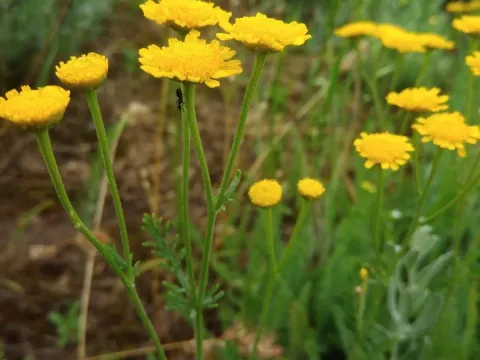
Yarrow tansy
Tanacetum millefolium
Yarrow tansy (Tanacetum millefolium), a member of the Asteraceae family, is typically sown in early spring once the danger of hard frost has passed.
What the section contains
Yarrow tansy
Direct seeding in the field requires a well-prepared seedbed; seeds should be sown shallowly, about 1 cm deep, to ensure optimal exposure to light for germination.
Row spacing is generally maintained at 50–60 cm to allow for efficient machine cultivation and to prevent overcrowding during the plant's growth cycles.
In regions with mild winters, autumn sowing is also a viable option, allowing the plants to establish a strong root system before the heat of summer.
Uniformity in sowing depth is essential for consistent seedling emergence, which typically occurs within two to three weeks under favorable conditions.
Native to the vast steppes and rocky slopes of Eurasia, Yarrow tansy is exceptionally well-adapted to arid and semi-arid environments.
The crop thrives in full sun and requires well-draining, slightly alkaline soil to prevent root rot and ensure healthy physiological development.
It is remarkably drought-tolerant, requiring minimal supplemental irrigation once the plants have been properly established in the field.
Soil fertility is important for biomass production, so light applications of balanced fertilizers are recommended during the early growth stages.
The plant exhibits high winter hardiness, surviving temperatures that would be fatal to less resilient Mediterranean aromatic species.
Yarrow tansy is primarily cultivated for the pharmaceutical and cosmetic industries due to its rich content of essential oils and specialized flavonoids.
The typical dry yield ranges from 1.5 to 2.5 tonnes per hectare, depending on soil quality, climatic conditions, and the age of the plantation.
Peak production is usually observed in the third year of cultivation, making it a sustainable and cost-effective perennial crop for farmers.
Harvesting efficiency is maximized when the crop is managed with standardized agricultural practices and mechanized harvesting equipment.
Consistent market demand for natural botanical ingredients keeps Yarrow tansy a stable niche crop for specialized herbal agriculture.
The primary pests affecting Yarrow tansy include aphids and leaf-eating beetles, which can significantly reduce foliage health if left uncontrolled.
Fungal diseases like powdery mildew may arise during periods of excessive humidity, necessitating good field sanitation and proper plant spacing.
Root rot is a major threat in poorly drained soils, making site selection the most important factor in preventing long-term crop loss.
Integrated pest management (IPM) strategies, including the use of biological controls, are highly recommended to maintain organic production standards.
Weed management during the first year is critical, as the crop establishes its root system and is vulnerable to competition from invasive grasses.
The harvest should be timed precisely for the peak of the flowering phase, ensuring that the concentration of volatile oils is at its maximum.
Mechanical harvesting is preferred, with cutter bars adjusted to collect the flowering tops and upper stems without disturbing the roots.
Once harvested, the plant material must be processed immediately to prevent heating and degradation of the delicate aromatic compounds.
For high-quality production, drying is performed in controlled-temperature facilities at 40–45°C until the desired moisture content is achieved.
Proper storage in cool, dark, and dry conditions is necessary to preserve the potency and market value of the harvested raw material.