
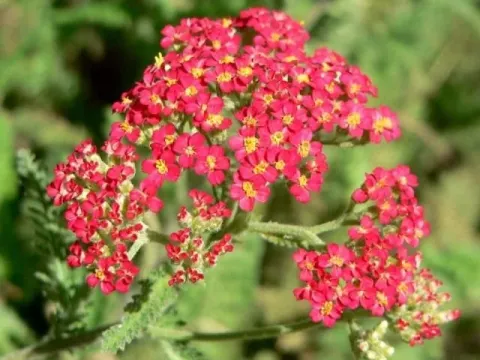
Yarrow hybrid
Achillea hybrids
Sowing seeds of Achillea hybrids for seedlings is carried out at the end of February or early March to obtain robust plants by the start of the summer season. The optimal temperature for seed germination is 18–20 degrees Celsius with sufficient light.
What the section contains
Yarrow hybrid
When sowing directly into open ground, the work is performed in May, once the danger of night frosts has passed and the soil has warmed up. Seeds are spread on the surface and lightly covered with substrate, as they require light to germinate.
To accelerate germination, seed trays are covered with transparent film or glass, maintaining high humidity. Seedling pricking out is performed when two to three true leaves appear, moving them into individual containers or peat pots.
Planting hardened seedlings in their permanent growth location occurs in the second half of May or early June. The distance between bushes should be between 30 and 45 centimeters, which ensures free air circulation and prevents overcrowding.
For vegetative propagation, bush division is used, performed in spring or early autumn. This method allows for the complete preservation of varietal characteristics of hybrid forms, which may segregate if propagated by seed.
The Yarrow hybrid is a low-maintenance perennial of the Asteraceae family, valued for its high adaptability and ornamental qualities. The plant prefers open, sunny areas, as stems in the shade become thin and lose strength.
The crop grows successfully in a wide variety of soil types, but it is most comfortable in light, well-drained soils with a neutral or slightly alkaline reaction. Heavy clay soils require the addition of sand to improve root aeration.
The plant possesses high drought resistance, making it a promising crop for regions with limited access to irrigation. Excessive moisture is more detrimental to Yarrow than short-term drought, so it is important to avoid areas with stagnant meltwater.
In natural conditions, hybrids originate from wild species distributed in the temperate latitudes of Eurasia and North America. Agronomy is focused on maintaining moderate fertility, as excess nitrogen fertilizers lead to excessive green mass growth at the expense of flowering.
The cold hardiness of Yarrow hybrids allows them to successfully overwinter in temperate conditions without additional covering. The crop responds excellently to regular soil loosening and weed removal in the root zone during the first year after planting.
Agricultural use of Yarrow includes harvesting the aerial part of the plant as medicinal raw material, as well as using it as a decorative element in landscape design. Inflorescences are collected during the period of mass flowering when they are fully open.
The yield of green mass directly depends on planting density and the quality of care. For industrial cultivation for medicinal purposes, up to 3–5 tons of dried raw material can be obtained per hectare if optimal plant spacing is followed.
In floriculture, productivity is evaluated by the number of flower stalks per bush, which can reach 20–30 under proper agronomic management. Regular pruning of faded inflorescences stimulates repeated flowering, increasing the overall aesthetic appeal of the crop throughout the season.
The quality of raw material is determined by the content of essential oils, tannins, and flavonoids. To preserve beneficial properties, collection is performed in dry weather, and drying is carried out in the shade under canopies or in specialized dryers at temperatures not exceeding 40 degrees.
The perennial maintains productivity in one location for 3–5 years. After this period, bushes begin to thicken, leading to a decrease in flower stalk quality, necessitating rejuvenation of the planting through rhizome division.
The main pests of Yarrow are aphids and bugs that damage young shoots and inflorescences by sucking cell sap. To combat them, biological preparations or systemic insecticides are used in cases of mass infestation of the crop.
Among fungal diseases, powdery mildew is the most common, occurring during high humidity and poor ventilation. Prevention consists of correct planting layout and timely weeding, while treatment involves application of copper or sulfur-based fungicides.
Rust can affect leaves during rainy summers, manifesting as brown spots. Affected plant parts must be removed and burned to prevent the spread of spores to healthy specimens within the area.
Sometimes, damage by stem nematodes is noted, leading to distorted shoots. In such cases, removing the entire affected bush with its root ball and following a crop rotation that excludes planting Asteraceae in that spot for several years is recommended.
Root rots can become a problem with systematic soil waterlogging. Preventing water stagnation and ensuring quality drainage are the best methods for protecting plants from soil pathogens.