
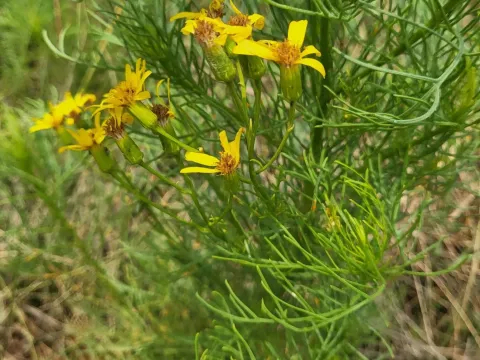
Riddell's ragwort
Senecio riddellii
Riddell's ragwort (Senecio riddellii) is a perennial herbaceous plant belonging to the Asteraceae family. In an agricultural context, it is recognized as a problematic weed that thrives in semi-arid environments.
What the section contains
Riddell's ragwort
Native to the prairies and dry regions of North America, this plant is well-adapted to habitats with low annual precipitation. It frequently colonizes disturbed soils where competition from native grasses is reduced.
The plant is characterized by its bright yellow flowers and distinct, narrow leaves. It possesses a woody base and a deep taproot system, which serves as an effective mechanism for surviving prolonged droughts.
Optimal growth occurs in areas with full sun exposure and well-drained, sandy or gravelly soil profiles. The species is highly resilient to wind and temperature fluctuations typical of arid climates.
Regarding its utility, the plant has no commercial agricultural value and is primarily viewed as a significant liability. Its potential for poisoning livestock makes it a major concern for rangeland management.
The primary threat posed by Riddell's ragwort is its high concentration of pyrrolizidine alkaloids, which are lethal to cattle and horses upon ingestion.
While the plant acts as a host for some specialized insects, it faces few severe pest pressures that could effectively control its population density.
Diseases such as various fungal blights may affect the plant during unseasonably wet seasons, but these rarely result in significant mortality of the stand.
The weed's deep root system ensures its survival against mechanical control methods, often leading to rapid regrowth following mowing or grazing pressure.
Effective management requires a comprehensive approach, as the plant spreads easily through wind-dispersed seeds, colonizing adjacent high-quality pasture lands.