
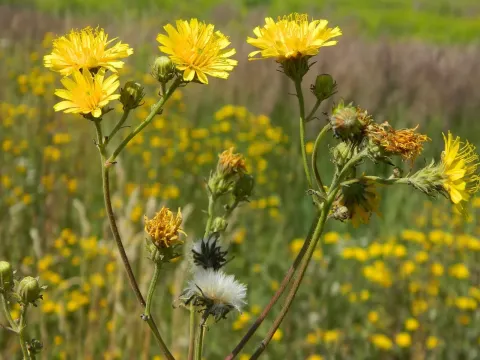
Picris rigida
Picris rigida
Picris rigida is a herbaceous perennial belonging to the Asteraceae family. Historically recognized for its hardiness, it has been studied for its adaptation to arid environments and its role within local ecosystems.
What the section contains
Picris rigida
The plant originates from Mediterranean and temperate regions. It thrives in well-drained, sandy or gravelly soils, exhibiting remarkable tolerance to poor nutrient profiles and limited water availability during the peak summer months.
Botanically, Picris rigida is characterized by its stiff, bristly hairs covering both stems and foliage, which serves as a defensive mechanism against herbivory and reduces water loss. It produces a rosette of lanceolate leaves from which a flowering stalk emerges.
Regarding climate, the plant demands full sun exposure to complete its life cycle effectively. It is highly photophilic and struggles to establish in shaded environments or within dense, competitive crop canopies.
Economically, the plant is primarily documented as a source of nectar for pollinators. While not a conventional commercial crop, its drought-resistant genes are of interest for plant breeding programs aimed at developing sustainable crops for arid regions.
The main pathological threats include fungal infections such as powdery mildew, particularly in environments with poor air circulation. These pathogens can compromise the photosynthetic capacity of the foliage if left unmanaged.
Common pests include aphids, which cluster on the underside of the leaves and on flower buds, as well as various leaf-mining insects that can cause significant damage to the plant's internal structure.
In agricultural settings, management involves physical removal or deep cultivation. Because of the plant's structural resistance, surface-level weeding often fails to destroy the deep taproot system, allowing for regrowth.
Chemical control programs often require specialized formulations with wetting agents. These agents help to bypass the protective hairs that otherwise prevent systemic herbicides from entering the plant vascular system.
Biological management includes encouraging natural predators, such as ladybugs and lacewings, which are highly effective at controlling aphid populations that frequent this plant species throughout the growing season.