
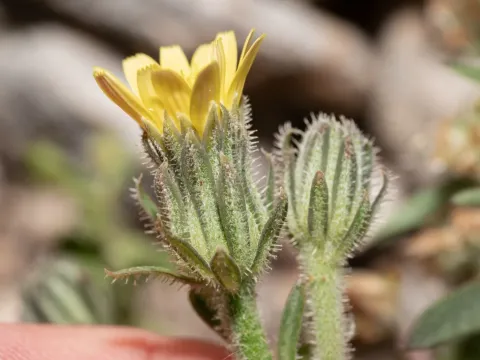
Picris pauciflora
Picris pauciflora
Picris pauciflora is an annual herb that completes its life cycle within a single growing season. Germination typically begins in spring when soil temperatures reach the threshold of 8–10 degrees Celsius, allowing the plant to establish itself early.
What the section contains
Picris pauciflora
The seeds can germinate in varying environmental conditions, often appearing in dense flushes after spring rains. Successful establishment depends heavily on seed placement, with optimal germination occurring at depths of 1 to 3 centimeters.
To control the proliferation of this species, agronomic practices such as shallow cultivation or harrowing before crop emergence are highly effective. These methods disrupt the young seedlings before they develop a deep root system.
In agricultural systems, the timing of seed germination often overlaps with the early stages of spring crop development, necessitating timely mechanical weeding to reduce competitive pressure on the main crop.
Effective management requires monitoring the field during the early vegetative phase. If the plant is allowed to reach the rosette stage without interference, control becomes significantly more labor-intensive and costly.
As a member of the Asteraceae family, Picris pauciflora thrives in sunny, open habitats. It is highly competitive in areas where light is abundant and shading from surrounding crops is minimal.
The species demonstrates high soil plasticity, adapting well to a variety of textures including sandy loams and heavier clay-based soils. It generally prefers neutral soil pH levels to achieve maximum biomass production.
Its deep taproot system allows for efficient water uptake from deeper soil layers, granting the plant significant drought tolerance during mid-summer heatwaves. This feature makes it a persistent weed in low-moisture environments.
Climatic requirements include a temperate climate with sufficient warmth during the vegetative period. It is well-suited to steppe and forest-steppe ecosystems where seasonal temperature variations are balanced by sufficient spring moisture.
Proper field maintenance, including ensuring high soil fertility for the primary crop, can help the intended culture outcompete the weed, although the resilience of this species remains a concern for integrated weed management programs.
Picris pauciflora is susceptible to common fungal pathogens that affect the Asteraceae family, such as powdery mildew. While these diseases can weaken the individual plant, they are rarely sufficient to eradicate a population completely.
Insect pests, including various aphid species, often colonize the foliage and flower buds. By extracting sap, these insects can cause stunted growth, though they rarely cause mortality in established populations.
Integrated Pest Management (IPM) strategies are essential for managing this species. Combining cultural practices like proper crop rotation with selective chemical herbicides can significantly reduce the weed seed bank over several years.
Mechanical interventions remain the cornerstone of control in organic systems. Regular cultivation and crop spacing optimization can deprive the weed of the sunlight and space required for its rapid growth.
Monitoring field edges and non-crop areas is vital, as these zones often serve as reservoirs for seeds. Preventing the plant from setting seed in these refugia is a critical step in long-term field maintenance.