
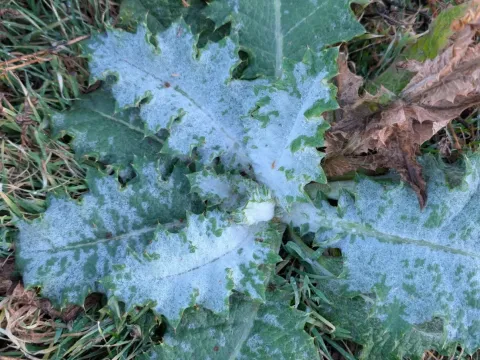
Cotton thistle
Onopordum
Cotton thistle is typically a biennial plant, requiring strategic planning for seeding in either early spring or late autumn for optimal germination.
What the section contains


Cotton thistle
Autumn sowing is often preferred in temperate climates as it allows the seeds to undergo natural stratification, leading to more uniform emergence.
Seeds should be planted at a shallow depth of 1-2 centimeters, as they require access to light and sufficient moisture to trigger the germination process.
Proper spacing is crucial to prevent seedling overcrowding, which can lead to suppressed growth and increased susceptibility to competitive stress.
Ensuring constant soil moisture during the first few weeks after sowing is essential for the establishment of the basal rosette phase.
This crop thrives in open, sunny environments and is highly adaptable to various soil types, particularly well-drained, nutrient-rich loam.
Onopordum exhibits remarkable drought tolerance due to its deep taproot, making it suitable for marginal lands and regions with low precipitation.
The plant prefers neutral to slightly alkaline soil conditions and can tolerate rocky or disturbed ground, often found in natural rangelands.
Good air circulation is vital for healthy development, meaning that field layout should account for the plant's significant width at maturity.
While the plant is hardy, it requires adequate phosphorus and potassium levels in the soil to support its rapid biomass accumulation during the second year.
Cotton thistle is highly regarded as a significant honey-producing plant, potentially yielding large quantities of nectar in favorable environmental conditions.
Biomass production for industrial or medicinal extraction is maximized when plants are harvested at the onset of the flowering stage.
The yield of seeds per hectare is substantial, allowing for efficient propagation and high turnover if managed with appropriate machinery.
Optimizing planting density and nutrition management can significantly boost the overall output of both floral heads and total vegetative mass.
Secondary compounds derived from the plant, such as sesquiterpene lactones, make it a valuable crop for specific pharmaceutical applications.
Common fungal diseases, including rust and powdery mildew, often occur in instances of poor ventilation or high humidity within the crop canopy.
Insect pests like weevils and aphids can cause significant damage to the floral buds, effectively reducing both seed yield and medicinal quality.
Root rot is a common threat in poorly drained soils, often aggravated by excessive precipitation or high clay content in the substrate.
Stem-boring insects may weaken the structural integrity of the plant, potentially leading to premature collapse before seed maturity.
Integrated pest management strategies should emphasize the use of clean seeds and crop rotation to minimize the pressure from soil-borne pathogens.
Harvesting for medicinal use requires precise timing, specifically when the flower heads are fully developed but before the seeds form fluffy pappi.
Post-harvest processing involves immediate drying in controlled, low-temperature environments to preserve the delicate volatile compounds in the plant.
Seed harvesting should be performed when the heads turn a brownish hue, indicating that the seeds have reached physiological maturity.
Modern machinery for harvesting must be calibrated to manage the light, wind-dispersed seeds to prevent loss during collection and transportation.
Residues left after harvest can be incorporated into the soil as organic matter, provided that they are free from major diseases or pest infestations.