
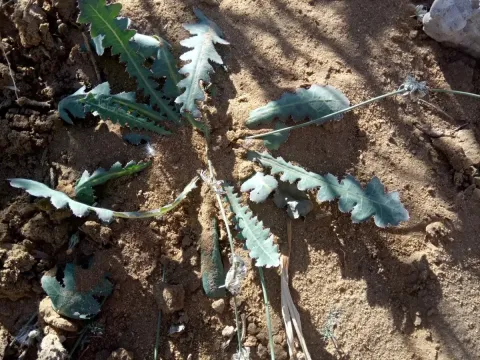
Launaea capitata
Launaea capitata
Launaea capitata is a perennial herbaceous plant belonging to the Asteraceae family. It is native to the arid and hyper-arid regions of North Africa, the Arabian Peninsula, and the Middle East, where it thrives in harsh desert environments.
What the section contains
Launaea capitata
The plant has evolved to require minimal rainfall, relying on its deep taproot system to access subsurface moisture. It grows effectively in sandy, silty, and rocky soils, demonstrating an impressive tolerance for high soil salinity and nutrient-poor substrates.
As a heliophyte, it demands high levels of solar radiation and is highly resistant to extreme diurnal temperature fluctuations. The morphology of the plant, characterized by a rosette of leaves, serves as an adaptation to reduce transpiration rates in heat.
Botanically, it features clustered flower heads, which are distinct within the genus. This structural arrangement helps protect the reproductive organs from desiccation during the intense heat of the desert blooming season.
In terms of agricultural and ecological utility, Launaea capitata serves as a vital forage resource for livestock such as camels, sheep, and goats. Furthermore, it plays a key role in land stabilization and desertification control efforts by anchoring loose sandy soils.