
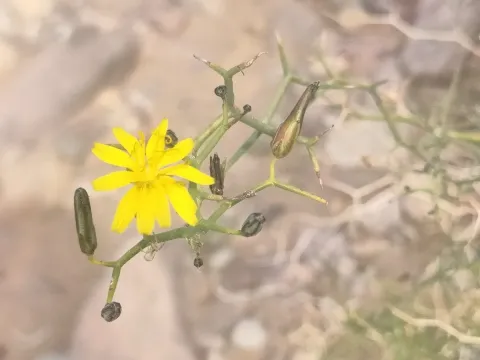
Launaea arborescens
Launaea arborescens
Launaea arborescens is a perennial shrub belonging to the Asteraceae family. It is a highly specialized xerophyte perfectly adapted to harsh environments found in North Africa and the Canary Islands.
What the section contains
Launaea arborescens
The plant thrives in sandy and rocky soils, often demonstrating remarkable tolerance to high salinity levels. It serves as a keystone species in maintaining the ecological balance of desert ecosystems.
Botanically, it features a dense, twiggy structure with small, fleshy leaves that are often shed during prolonged drought. The green, photosynthetic stems allow the plant to continue growing even when water is extremely scarce.
Optimal growth conditions require full sun exposure and excellent soil drainage. It is a slow-growing species, but once established, it possesses a deep root system that secures its long-term survival.
In agricultural practice, this plant is primarily valued for land reclamation and as a reliable source of emergency fodder for livestock, such as camels and goats, in arid regions.
The primary threat to Launaea arborescens populations is overgrazing by domestic livestock, which prevents the plant from setting seed and recovering its biomass.
The plant is relatively resistant to diseases due to its chemical composition, which includes latex and secondary metabolites that deter many herbivores and pathogens.
Root rot caused by waterlogging is the most significant physiological threat, as the plant is not equipped to handle stagnant water around its root zone for extended periods.
Insect pests are generally not a concern, though localized damage from certain beetles may occur if the plant is grown outside its natural bioclimatic range.
Human activity, including land clearance for infrastructure, poses a constant threat to the preservation of natural habitats where this species contributes to biodiversity.