
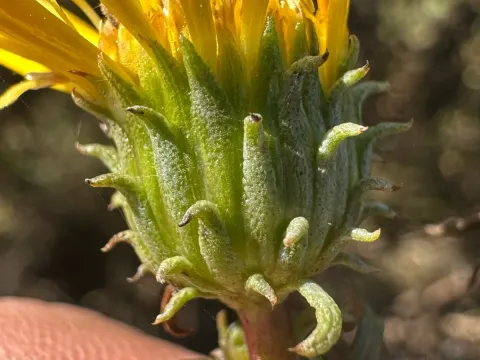
Red-stem gumweed
Grindelia rubricaulis
Grindelia rubricaulis is a hardy perennial member of the Asteraceae family. For optimal establishment, sowing should occur in early spring as soon as the soil reaches temperatures between 10 and 12 degrees Celsius, facilitating consistent germination.
What the section contains
Red-stem gumweed
Seeds are relatively small and require precise planting depths of 1 to 2 centimeters. Ensuring good seed-to-soil contact is essential for success, which is typically achieved by lightly rolling the soil surface immediately after seeding.
Row spacing should be maintained between 45 and 60 centimeters. This provides enough space for initial development and allows for mechanical weeding, which is vital during the crop's slow-growing establishment phase in the first year.
Stratification of seeds can improve germination rates, especially in colder climates. Sowing should be avoided in waterlogged areas, as damp, cold conditions during germination can lead to seed decay and poor stand density.
In arid regions, planting can sometimes be performed in late autumn, allowing the seeds to germinate early in the spring, taking advantage of residual winter soil moisture for faster initial growth.
This species thrives in well-drained, sandy or loamy soils with a neutral to slightly alkaline pH. It is highly adapted to dry environments, making it suitable for areas where water management is critical.
Full sun exposure is mandatory for this crop. Reduced sunlight significantly impacts the production of essential resins and flavonoids, which are the primary active compounds that define the plant's medicinal and economic value.
While drought-tolerant, Grindelia rubricaulis benefits from supplemental irrigation during its peak vegetative growth and flower bud initiation phases, particularly if spring rainfall is below average.
Soil fertility management should focus on balanced phosphorus and potassium levels, which strengthen the plant's overall architecture and enhance its ability to withstand seasonal temperature variations.
The plant is resilient but requires protection from excessive stagnant moisture, which can cause root rot. Planting on raised beds can be an effective strategy in regions with unpredictable rainfall patterns.
The economic yield of Grindelia rubricaulis consists of the harvestable aerial parts, primarily the leafy stems and flower heads covered in resinous exudates. Yields vary based on soil fertility and plant age.
Average dry biomass yields range between 1.5 and 3 tonnes per hectare. A well-managed plantation can remain productive for several years, with biomass quality usually peaking in the second and third years of cultivation.
The concentration of secondary metabolites, such as grindelic acid, is at its highest during the early full bloom stage. Harvesting at this specific developmental window is critical for maximizing commercial value.
The drying process must be carefully monitored to preserve the resin content. Improper drying or storage temperatures exceeding 50 degrees Celsius can lead to the degradation of essential oils and active resinous components.
Market demand is largely driven by the pharmaceutical industry. Providing a high-purity product with minimal foreign matter and high resin content is the primary goal for professional producers.
Root rot is the most common pathology, especially in heavier soils with poor drainage. Implementation of a crop rotation schedule helps reduce the accumulation of soil-borne pathogens over time.
Powdery mildew can become a significant issue during periods of high humidity or poor field ventilation. Pruning and ensuring adequate plant spacing are effective preventive measures against fungal outbreaks.
Pests like aphids can colonize the sticky flower heads, damaging the plant's ability to produce quality resin. Integrated pest management strategies, including the use of beneficial insects, are recommended.
Weed competition is the greatest threat to young plantings. The species lacks aggressive initial growth, so keeping the rows clear of weeds during the first two months is paramount for crop success.
Various beetles may also feed on the foliage, although they rarely cause catastrophic damage unless the plants are already stressed. Maintaining soil health and plant vigor is the best defense against minor pest infestations.
Harvesting is performed by cutting the stems at approximately 10-15 centimeters above the ground. This height allows for rapid regrowth, which is vital if multiple harvests within a single season are desired under irrigation.
Post-harvest handling requires immediate transfer of the biomass to a drying facility. The resinous nature of the flower heads makes them prone to sticking together if piled too high while still fresh.
Drying is best accomplished in well-ventilated, shaded environments to maintain the natural color and potency of the plant parts. Controlled temperature drying systems (under 45 degrees Celsius) are preferred for efficiency.
Once dried, the product should be cleaned to remove debris and dust. Standardizing the product through sieving or mechanical sorting helps meet the quality specifications required for medical grade botanical raw materials.
Storage should occur in cool, dark, and dry conditions. Since the plant is resinous, it must be protected from extreme heat which could cause clumping, complicating the downstream extraction processes.