
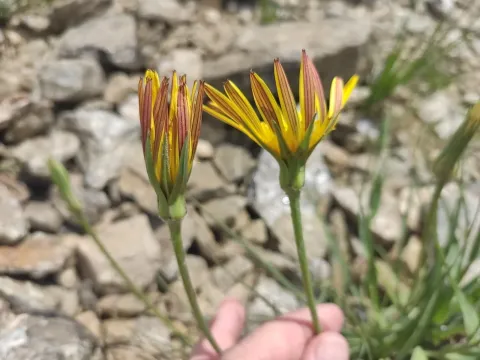
Reticulated salsify
Tragopogon reticulatus
Reticulated salsify (Tragopogon reticulatus) belongs to the Asteraceae family. It is a biennial or perennial herbaceous plant known for its edible taproot, similar to common salsify.
What the section contains
Reticulated salsify
The plant thrives in deep, well-drained, sandy loam soils that allow the taproot to develop straight and smooth without structural obstacles.
As a sun-loving species, it requires full exposure to sunlight to photosynthesize effectively and build up sugar reserves in the root during the growing season.
It demonstrates remarkable resilience to drought, making it suitable for regions with limited rainfall, provided the soil moisture is sufficient during the early stages of establishment.
Proper soil preparation, including deep plowing, is essential, as this helps to prevent the bifurcation of roots, which is a common problem in hard-packed soils.
Harvesting usually takes place in late autumn when the foliage begins to wither, signaling that the plant has stored energy in its root system.
The roots should be lifted carefully from the ground using a digging fork, ensuring the entire length of the taproot is extracted without snapping.
Post-harvest care involves brushing off loose soil and allowing the roots to air-dry slightly before storage to prevent mold growth on the surface.
For best results, store the roots in a cool, dark, and humid environment to maintain their crunchiness and nutritional value for several months.
It is important to avoid freezing temperatures during long-term storage, although the plant itself is frost-hardy and can often be left in the ground until needed.