
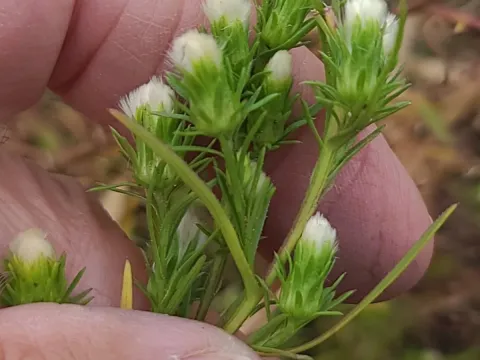
Rayless annual aster
Symphyotrichum ciliatum
Rayless annual aster (Symphyotrichum ciliatum) belongs to the Asteraceae family. It is an annual herbaceous plant native to North America that has successfully naturalized in various regions of Eurasia.
What the section contains
Rayless annual aster
The plant is categorized as a halophyte, which enables it to thrive in saline soil conditions where many other species fail to survive. It is frequently identified in salt marshes, saline lake shores, and damp prairie habitats.
Botanically, it features simple, lance-shaped leaves and inconspicuous flower heads, which distinguish it from more ornamental aster species. Its root system is highly adapted to nutrient-poor and saline substrates.
The species has specific climate requirements including tolerance to cold temperatures and a high demand for solar radiation to complete its life cycle effectively.
Effective management requires understanding its preference for moist, disturbed soils, as it often appears as a colonizer in areas where natural vegetation cover has been compromised.
Rayless annual aster is remarkably resilient and is not typically susceptible to the common pathogens that impact commercial Asteraceae crops.
Pest pressure is generally low, as the plant possesses natural chemical defenses and structural adaptations that limit insect feeding and herbivory.
In farming, it is often viewed as a competitive weed that can reduce crop yields if left unmanaged on saline agricultural lands.
Agricultural control strategies involve regular mechanical tillage and proper soil drainage management to minimize the favorable conditions for its germination.
Integrated weed management practices should include pre-emergence control and monitoring to prevent the seed bank buildup, ensuring long-term field productivity.