
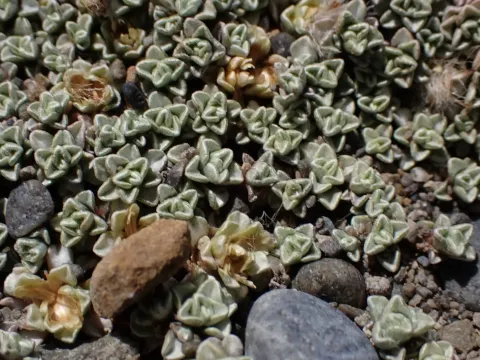
Raoulia hookeri
Raoulia hookeri
Raoulia hookeri is a low-growing perennial herb belonging to the Asteraceae family. Native to the rocky slopes and stony riverbeds of New Zealand, this plant is highly prized in horticulture for its dense, silvery-grey foliage that forms compact mats across the ground.
What the section contains
Raoulia hookeri
The botanical structure of this species is adapted to harsh conditions. Its tiny leaves are covered in dense, fine hairs, providing a metallic appearance and helping the plant manage moisture and solar radiation. It typically thrives in high-altitude environments where drainage is sharp and instantaneous.
Cultivation requirements are strict regarding drainage. Raoulia hookeri cannot survive in heavy, water-retentive soils. It is best grown in specialized alpine troughs, rock gardens, or scree beds composed of a coarse mix of grit, gravel, and sand, which ensures the root zone remains aerobic.
The plant requires full sun to maintain its compact habit and vibrant silver coloration. In low-light conditions, the stems tend to elongate and lose their characteristic density, making the plant less ornamental and significantly more susceptible to environmental stress.
Climate adaptation is a key factor; while it is cold-hardy, it performs best in regions with cool summers and good air circulation. In climates with high humidity or heavy rainfall, the plant requires protection from moisture to prevent the center of the mat from rotting.
The most significant threat to Raoulia hookeri is fungal infection caused by stagnant moisture. Root rot and damping-off are common issues that occur when the plant sits in soggy soil, quickly destroying the tight foliage mats that are the hallmark of this species.
Slugs and snails can pose a challenge during wet spells, feeding on the tender foliage. Gardeners often use a top dressing of sharp gravel or grit around the plant to deter these pests and keep the lower stems dry, preventing contact with wet soil.
Winter damage, specifically related to freeze-thaw cycles in the absence of snow cover, can also weaken the plant. In extreme cold, providing a light, dry protective cover can help maintain plant vigor and prevent crown injury during the dormant season.
Poor air circulation is a common cultural error that leads to health issues. If the plant is surrounded by taller, encroaching vegetation, humidity levels rise, creating a microclimate favorable for fungal outbreaks and bacterial spots within the mat.
Effective management involves consistent sanitation and ensuring the site remains free-draining throughout the year. If patches of decay appear, they should be removed promptly, and the area treated with a suitable fungicide to prevent further spread.