
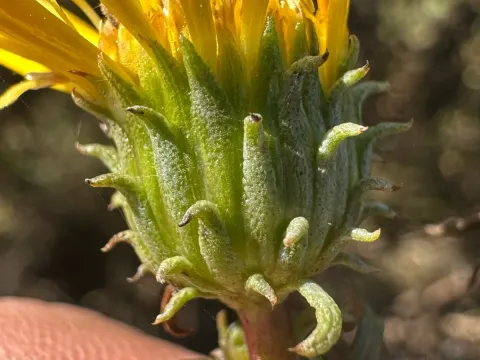
Grindelia camporum
Grindelia camporum
Grindelia camporum is a hardy perennial or biennial plant that is typically sown in early spring when soil temperatures reach 10–12°C. In regions with milder climates, dormant autumn sowing can also be successfully practiced to facilitate early spring germination.
What the section contains
Grindelia camporum
The seeds of this plant are quite small, necessitating a finely prepared seedbed to ensure proper soil-to-seed contact. The seeds should be sown at a depth of 1–2 centimeters to avoid emergence failure.
A row spacing of 45 to 60 centimeters is recommended, as this setup allows for mechanical cultivation to control weeds effectively during the plant's early growth stages.
Precision planters are highly recommended for sowing to achieve a uniform plant density, which is essential for maximizing yield in large-scale agricultural production.
Thinning may be necessary shortly after emergence if the seedling density is too high, ensuring that each plant has enough space to develop its characteristic resinous canopy.
As a member of the Asteraceae family, Grindelia camporum is exceptionally drought-tolerant and well-adapted to arid or semi-arid environments where other crops might fail.
It prefers well-drained, sandy, or sandy-loam soils. Excess moisture and waterlogged conditions must be strictly avoided, as the plant is highly susceptible to root rot in poorly aerated environments.
The plant thrives in full sun, which is essential for the production of the resinous substances for which it is commercially grown. It performs well in neutral to slightly alkaline soil conditions.
While extremely drought-resistant once established, providing supplemental irrigation during the budding phase can significantly increase the total biomass production.
Its ability to tolerate saline soils makes it a promising candidate for the reclamation of degraded and marginal agricultural lands.
The yield of Grindelia camporum is largely determined by environmental conditions, particularly sunlight exposure and moisture levels during the peak flowering stage.
Producers can typically expect a dry biomass yield ranging from 2 to 4 tons per hectare, depending on the management intensity and the specific crop cycle.
The primary economic value of the crop lies in the production of resins. Proper fertilization, particularly with potassium and phosphorus, is crucial for increasing both biomass and resin quality.
Second-year plants generally produce a higher yield compared to the first year, as the plant has developed a more robust root system and a larger structural base.
Effective management practices, including timely harvesting and appropriate drying conditions, are essential to maintain the high quality of the raw material for pharmaceutical use.
The primary threats to Grindelia camporum include various fungal pathogens that flourish in high-humidity conditions or due to poor crop rotation practices.
Pests such as aphids and certain types of weevils can cause significant damage to foliage and flower buds, negatively impacting the quality of the resinous harvest.
Weed competition is a critical concern during the first few weeks of the crop cycle, as the seedlings are initially slow to grow and can be easily outcompeted by aggressive weeds.
Implementing a strict rotation schedule—avoiding the same ground for at least 3–4 years—is the most effective cultural method to minimize disease pressure.
Careful monitoring and integrated pest management (IPM) strategies are required to keep pest populations below economic threshold levels without compromising the medicinal quality of the crop.
Harvesting for pharmaceutical or industrial resin production should take place at the peak of the flowering stage, when the buds are covered in the highest concentration of sticky resin.
The aerial parts must be harvested during dry weather and processed immediately to prevent heating and the loss of volatile compounds caused by spontaneous fermentation.
Drying should be conducted in shaded, well-ventilated areas or specialized forced-air dryers, ensuring temperatures do not exceed 45°C to preserve the integrity of the chemical constituents.
If harvesting for seeds, it is best to allow the heads to dry partially on the plant before mechanical harvest to minimize shattering and yield losses.
Once dried and threshed, the seeds should be cleaned, graded, and stored in cool, dry conditions to ensure high viability for subsequent planting seasons.