
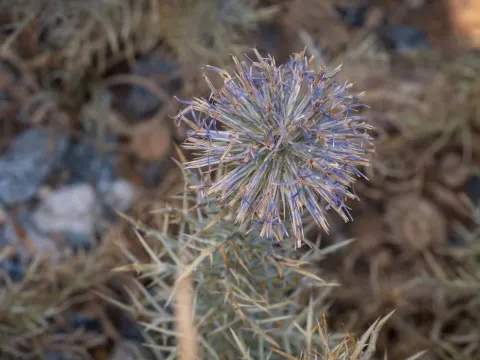
Greek globe thistle
Echinops graecus
Sowing seeds of Echinops graecus is best performed in early spring once the soil temperature reaches at least 8–10 degrees Celsius, or as a late autumn sowing.
What the section contains
Greek globe thistle
Seeds should be planted with row spacing of 60–70 centimeters to accommodate the large, sprawling leaf rosettes that characterize this species.
The optimal planting depth is approximately 2–3 centimeters, followed by light soil compaction to ensure good seed-to-soil contact for germination.
Seedlings emerge within two to three weeks, during which period intensive weed control is essential to prevent overcrowding and nutrient competition.
As a perennial species, site selection is critical, as the crop will occupy the same plot for several years without the need for relocation.
Greek globe thistle belongs to the Asteraceae family and is a xerophytic plant, evolutionary adapted to thrive in moisture-deficient environments.
The plant performs best in full sun on well-drained, sandy or rocky soil types, showing extreme intolerance to waterlogged or heavy clay conditions.
Its deep taproot system allows the crop to withstand prolonged periods of drought and high summer temperatures by accessing deep subsoil water.
Soils rich in limestone are highly favorable for this species, often resulting in more robust plant growth and significantly improved nectar secretion.
The plant displays good winter hardiness in temperate regions, although it may benefit from light mulching during severe winters with no snow cover.
The primary agricultural use for Echinops graecus is apiculture, as it is considered a premium honey plant with a high concentration of sugar in its nectar.
Under optimal agronomic conditions, a well-established stand can produce between 300 and 600 kilograms of high-quality medicinal honey per hectare.
Beyond its value to beekeepers, the plant is harvested for pharmaceutical purposes to extract the alkaloid echinopsine from its flower heads.
The peak honey production yield is typically observed during the second and third years of growth, once the root system is fully developed.
The seeds are also commercially valuable as a source of botanical oils and specific plant extracts used in traditional and modern herbal medicine.
Weevils are among the most persistent pests, specifically targeting the flower heads and significantly reducing both seed yields and nectar production.
In high humidity environments with poor airflow, the plant is susceptible to powdery mildew, which manifests as a white fungal coating on the foliage.
Root rot is a major threat when the crop is planted in dense, poorly drained soils, often leading to rapid decline and plant death during wet cycles.
Aphids may occasionally colonize the soft, emerging flower stalks, sapping plant energy and potentially transmitting viral diseases to the colony.
- Proper site drainage
- Integrated pest management
- Regular weeding
- Monitoring of flower heads
Harvesting flower heads for medicinal use should occur at the peak of the flowering phase when the spheres are firm and fully colored.
Seed collection is performed after the flower heads have turned brown and dried on the plant, minimizing the loss due to natural seed shattering.
The harvested material must be dried in a shaded, well-ventilated area or a commercial dryer at temperatures not exceeding 45 degrees Celsius.
After drying, the heads are threshed to release the seeds, which are then cleaned through a series of sieves to remove debris and scales.
Final storage of the seeds or dry plant material requires a cool, moisture-free environment to preserve its potency and prevent the development of mold.