
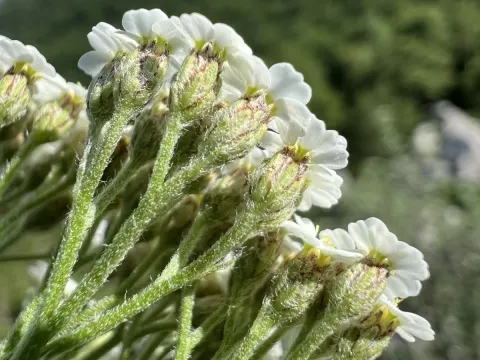
Green yarrow
Achillea virescens
Achillea virescens, commonly known as green yarrow, is a hardy perennial belonging to the Asteraceae family. It is native to the mountainous regions of Southern and Central Europe, where it thrives in diverse ecological niches.
What the section contains
Green yarrow
The plant features distinct green foliage and displays a high level of environmental plasticity. It prefers full sun exposure and well-draining, slightly alkaline to neutral soils, showing remarkable tolerance for nutrient-poor substrates.
As a drought-tolerant crop, it is ideal for regions with irregular rainfall. Its deep root system allows it to access moisture far below the surface, making it an excellent candidate for low-maintenance cultivation.
Cultivation should prioritize soil aeration. Heavy, clay-rich soils should be amended with organic matter or grit to ensure proper drainage and prevent the root rot to which the species is particularly susceptible.
Beyond its medicinal applications, which include the production of essential oils and anti-inflammatory compounds, green yarrow is widely used in xeriscaping due to its durability and minimal water requirements.
Powdery mildew is the most prevalent fungal disease affecting Achillea virescens, typically triggered by high humidity levels and insufficient airflow in dense planting schemes.
Pests such as aphids and leaf miners often target the foliage during the early stages of growth, potentially stunting development and reducing the quality of the harvestable material.
Rust diseases can occur during prolonged wet spells, manifesting as reddish-brown pustules on the undersides of the leaves, which requires immediate pruning of infected stalks to prevent spread.
Integrated pest management strategies are highly recommended. This includes encouraging natural predators like ladybugs and ensuring correct plant spacing to facilitate rapid drying of leaves after rain.
Soil-borne pathogens can be minimized by implementing strict crop rotation protocols and ensuring the fields remain free of debris that could serve as overwintering sites for insects or fungal spores.