
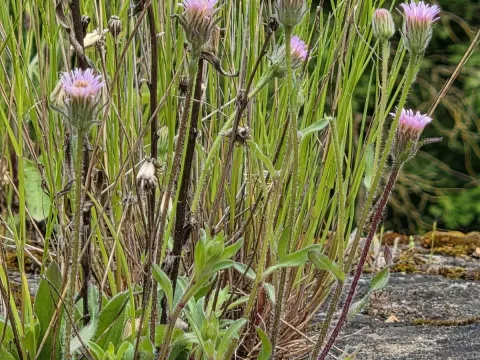
Blue fleabane
Erigeron acris
Blue fleabane (Erigeron acris) is a herbaceous perennial or biennial plant belonging to the Asteraceae family. It is widely distributed across the Northern Hemisphere, inhabiting diverse environments such as meadows, dry grasslands, and disturbed habitats. Its resilience makes it a notable species in various ecological settings.
What the section contains
Blue fleabane
Botanically, the plant features an erect, often hairy stem that reaches heights between 10 and 60 centimeters. The leaves are predominantly lanceolate, with the basal ones forming a rosette. The flower heads are typically arranged in a branched panicle, displaying yellow central florets surrounded by paler, sometimes pinkish or purple ray florets, which distinguish it from other Erigeron species.
Regarding cultivation requirements, Blue fleabane is known for its low demand for soil fertility. It thrives in well-drained, sandy, or stony soils and is highly adapted to neutral to slightly alkaline pH levels. It requires full sun exposure for optimal growth and flowering, showing remarkable tolerance to drought conditions due to its efficient, deep-reaching taproot system.
In terms of agricultural and practical use, the plant has a long history in traditional herbal medicine, primarily valued for its anti-inflammatory and astringent properties. Furthermore, it serves as an important nectar source for pollinators, making it a beneficial component for biodiversity-focused agricultural projects and wildflower meadows.
Management of the plant in a landscape or agricultural context is relatively straightforward. It spreads primarily via wind-dispersed seeds, requiring minimal intervention if the goal is to establish a perennial patch. If utilized for commercial harvest of herbal raw materials, selective cutting during the flowering stage is recommended to preserve plant vitality and ensure quality.
Blue fleabane is generally robust, but it can be susceptible to common garden pests such as aphids during periods of environmental stress. Fungal issues like powdery mildew may occur if planting density is too high or if air circulation is insufficient. Ensuring proper spacing and avoiding waterlogged conditions are the primary methods for preventing these botanical threats.