
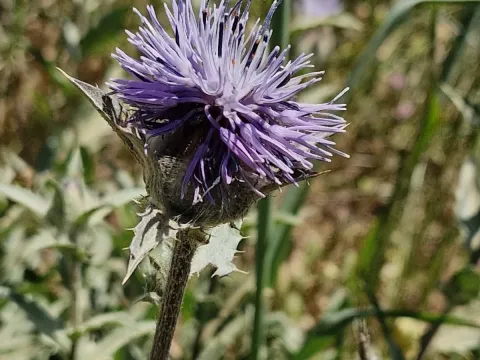
Blue safflower
Carthamus caeruleus
Blue safflower is a highly drought-tolerant plant, making early spring the ideal sowing time, specifically when the soil reaches its physical maturity for cultivation.
What the section contains
Blue safflower
Seeds should be sown when the topsoil reaches temperatures between 5 and 8 degrees Celsius, which encourages rapid and uniform seedling emergence.
The seeding depth usually ranges from 3 to 5 centimeters, depending on soil texture, ensuring that the seeds maintain good contact with the moist soil layer.
In regions with mild winters, late autumn sowing is sometimes practiced, although early spring remains the preferred method to avoid frost damage to early seedlings.
Standard seeding rates range from 40 to 60 kilograms per hectare, depending on the row spacing chosen, ensuring optimal plant density for maximizing potential yields.
As a member of the Asteraceae family, Blue safflower features a deep taproot system capable of extracting moisture from deeper soil layers, proving vital in arid climates.
The crop thrives in well-drained chernozem or chestnut soils with a neutral pH level, avoiding areas prone to waterlogging or high groundwater tables.
Being a heliophilic plant, Blue safflower requires intense sunlight throughout its growth cycle; therefore, planting in open, unshaded fields is an essential requirement.
While moderately demanding regarding temperature, the plant shows significant resistance to early spring cold spells, allowing for safe planting earlier in the season.
During the flowering and seed-filling stages, moderate moisture availability is beneficial, although the plant remains one of the most efficient crops in water-deficient environments.
The primary threats to Blue safflower health include fungal diseases such as rust and Fusarium wilt, which tend to proliferate in conditions of high environmental humidity.
Major insect pests include soil-dwelling larvae like wireworms, which damage root systems, and aphids that can colonize buds and leaves during the vegetative stage.
Effective disease management relies on a strict crop rotation strategy, ensuring that safflower is not planted in the same soil more than once every four years.
Chemical control via fungicides or insecticides should only be employed after assessing the economic damage threshold to maintain the crop's ecological safety profile.
Mechanical weed control, particularly through inter-row cultivation, helps suppress competing vegetation while improving soil aeration and moisture retention.
Harvesting should occur at the stage of full maturity, when flower heads turn brown and the moisture content of the seeds drops to a safe 10–12 percent level.
Direct combining is the standard harvesting method, as it reduces grain losses that often occur during the more complex windrowing or swathing processes.
Proper combine settings, particularly the drum speed, are critical to avoid damaging the seed coats, which contain high concentrations of valuable oils.
Post-harvest, seeds must be cleaned of impurities and dried thoroughly to meet storage requirements and prevent the deterioration of oil quality over time.
In cases of uneven maturation or unfavorable autumn weather, desiccation is often utilized to unify the drying process and facilitate efficient machine harvesting.