
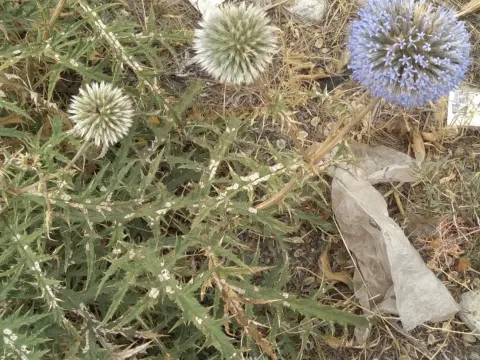
Oriental globe thistle
Echinops orientalis
Oriental globe thistle (Echinops orientalis) is a perennial herbaceous plant belonging to the Asteraceae family. The crop is distinguished by high cold and drought tolerance, making it suitable for cultivation in regions with continental climates.
What the section contains
Oriental globe thistle
Seeds are typically sown in late autumn or early spring. Autumn sowing allows the seeds to undergo natural stratification in the soil, which leads to more uniform and vigorous germination during the spring period.
The planting depth should be 1.5–2 centimeters, given the small size of the seeds. For spring sowing, it is essential to ensure the soil is sufficiently warmed, and pre-treatment of the seed material can significantly improve emergence rates.
To establish productive stands, seeds are sown using wide-row spacing methods. Keeping rows 45 to 60 centimeters apart facilitates easier maintenance and weed control throughout the growing season.
In the first year of growth, the globe thistle forms a developed rosette of basal leaves and a powerful root system. Flowering and the development of reproductive stems generally occur starting from the second year of cultivation.
This plant does not have high requirements for soil fertility; however, the best yield indicators are achieved on light sandy loam and chernozem soils with proper drainage.
The Oriental globe thistle is highly demanding in terms of sunlight. For successful growth and high-quality flowering, the crop requires open, well-warmed sunny sites protected from stagnant cold air.
The plant possesses high drought resistance due to its strong taproot that penetrates deep into the soil. Excessive moisture and high groundwater levels are detrimental to the plant, as they frequently lead to root rot.
The optimal temperature range for the development of Echinops orientalis is between +20 and +25 degrees Celsius. During the vegetative stage, the plant handles short periods of summer heat well without reducing the accumulation of bioactive compounds.
Agrotechnology for this crop includes mandatory inter-row cultivation during the first two years after sowing. This prevents crust formation on the soil surface and ensures adequate oxygen access for the root system.
The primary economic purpose of the Oriental globe thistle is its function as a high-quality honey-producing crop. It is considered one of the best honey plants, capable of secreting nectar even in dry years.
Honey productivity from dense stands of this plant can reach 300–500 kilograms per hectare. Its nectar is characterized by a high sugar content, making it a target for honeybees throughout the flowering duration.
Beyond its honey-producing potential, the seeds of this plant are used in pharmacology to extract echinopsine — an alkaloid known for its ability to stimulate the central nervous system and improve nerve impulse conduction.
The plant's biomass can also be utilized as a raw material for feed additives or mulching materials, although these applications are significantly less developed than its primary role as a major melliferous crop.
The flowering period lasts approximately 30–40 days, which provides honeybee colonies with a stable nectar source in mid-summer when other melliferous herbs have already completed their cycle.
Oriental globe thistle possesses high phytosanitary resistance; however, under conditions of high humidity, the plant may be susceptible to fungal diseases such as powdery mildew or gray mold.
Among pests, weevils and various types of caterpillars pose the greatest threat, as they can damage the leaf apparatus or reproductive organs, thereby reducing the quality of the seed yield.
To prevent the spread of diseases, it is important to follow crop rotation practices and avoid excessive plant density. Maintaining optimal distance between plants ensures effective airflow throughout the field.
Weed management is critical during the early stages of growth. Once established, the plant's robust leaf rosette allows it to effectively suppress competing vegetation in the inter-rows.
When pest outbreaks occur, the use of biological insecticides is recommended if the crop is intended for honey production, ensuring the safety of honeybee populations.
Seed harvesting is conducted in the full maturity phase when the flower heads turn grayish-brown and the seeds easily detach upon a light tap on the inflorescence.
It is important not to delay the harvesting process, as the seeds of the globe thistle can easily shatter during strong winds or due to improper handling of the reproductive stems.
The harvested inflorescences are dried under a canopy or in well-ventilated indoor facilities, after which threshing is carried out using specialized machinery or by hand for small-scale production.
After threshing, the seeds undergo a cleaning process to remove fluff and impurities using winnowing machines. Storing the cleaned seed material is recommended in dry, cool rooms with adequate ventilation.
To maintain soil fertility after the crop's cultivation cycle is complete, plant residues can be shredded and incorporated into the soil as green manure.