
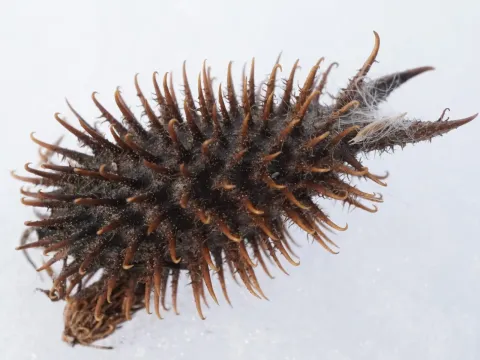
Oriental cocklebur
Xanthium orientale
The Oriental cocklebur (Xanthium orientale) belongs to the Asteraceae family. It is an annual herbaceous plant widely recognized as a serious agricultural weed, known for its extreme competitive ability and rapid spread in diverse cropping systems.
What the section contains
Oriental cocklebur
Originally native to North America, this species has successfully naturalized across many regions of the world. Its ability to thrive in disturbed habitats makes it a constant threat to intensive agricultural practices and field management.
Morphologically, the plant is characterized by a sturdy, branching stem that can grow over one meter in height. Its broad, heart-shaped leaves have serrated margins and are covered in coarse hairs, providing a distinct appearance in the field.
The plant demonstrates high adaptability to various soil types, preferring moist and nutrient-rich environments. It is frequently found in irrigation channels, crop borders, and fallow fields, where it can easily outcompete slow-growing crops for essential sunlight and water.
Economic impact is primarily due to the reduction of crop yields and the high cost of mechanical or chemical control. The seeds, enclosed in spiny burs, can survive for several years in the soil, creating a long-term management challenge for farmers.
Oriental cocklebur can serve as an alternative host for several plant diseases, including various species of mildew and rust fungi. These pathogens can easily spread from the weed to adjacent commercial crops, causing significant economic losses.
Specific insect pests often target the cocklebur, such as certain beetles or weevils that feed on foliage or developing seeds. While these insects cause visible damage, they are generally ineffective as biological control agents in large-scale agricultural settings.
Integrated weed management is crucial for controlling Xanthium orientale. This involves combining pre-emergent and post-emergent herbicide applications with timely mechanical cultivation to disturb the root systems before the plant matures.
Field sanitation is a fundamental step in preventing further spread. Cleaning agricultural machinery after working in infested areas and preventing the weed from going to seed along field margins significantly lowers the seed bank density.
Livestock safety is another concern, as the plant possesses toxic properties. Consumption by cattle or sheep can lead to severe poisoning, particularly when the plants are in the seedling stage, making its eradication from pastures and forage land essential.