
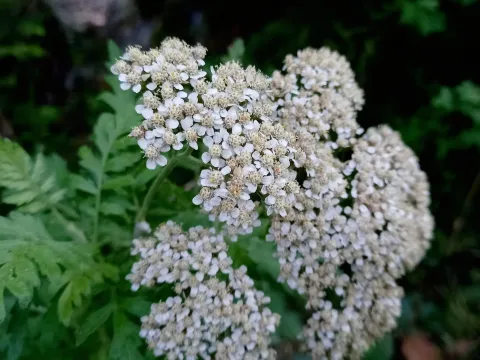
Great-leaved yarrow
Achillea grandifolia
Great-leaved yarrow (Achillea grandifolia) is a perennial herbaceous plant belonging to the Asteraceae family. For industrial cultivation, seeds are sown primarily in the spring when the soil warms up to 10-12 degrees Celsius, or late in the autumn in prepared seedbeds.
What the section contains
Great-leaved yarrow
When sowing in open ground, seeds should be planted at a depth of no more than 1-1.5 centimeters, as they are small and require adequate light for successful germination. It is crucial to maintain sufficient soil moisture during the first few weeks after emergence to prevent the young seedlings from drying out.
In large-scale production, row spacing of approximately 45-60 centimeters is recommended. This layout allows for the mechanization of weeding and soil cultivation processes, which are vital for the development of a strong root system during the first year of the crop's life.
By the second year, the plants form a dense leaf rosette that produces flower stalks by early summer. The optimal planting density is approximately 8-10 plants per square meter to ensure high productivity of high-quality raw materials.
Using a transplant method can significantly reduce the time required to harvest marketable products. Seedlings are grown in greenhouses for 45-60 days before being transplanted into open fields, ensuring uniform stands and better crop establishment.
The plant prefers sunny locations with well-drained, moderately fertile soils. While it exhibits high drought tolerance, regular watering during peak vegetative growth periods is necessary to obtain high-quality medicinal raw materials.
The optimal soil pH range for this crop is between 6.0 and 7.5. Excessive moisture and waterlogged soils are detrimental to the root system, a factor that must be strictly considered when selecting a site for establishing a plantation.
Agricultural management requires balanced mineral fertilization. In the early spring, nitrogen-based fertilizers are preferred to stimulate green mass growth, while pre-flowering applications of potassium-phosphorus blends help accumulate essential bioactive compounds.
The crop is winter-hardy and capable of withstanding significant temperature drops in temperate climates. In northern regions, light protective covering may be necessary during the first few years to prevent winterkill in the absence of sufficient snow cover.
Weed management is a critical aspect of early-stage care. Since yarrow grows slowly in the first months of development, the timely removal of competing vegetation is essential to prevent the suppression of the crops.
The productivity of Achillea grandifolia depends on the age of the plantation and the quality of agricultural management. Peak yields of aerial parts are achieved in the second and third years after planting, making it a viable multi-year crop for commercial farmers.
Average dry biomass yields vary depending on management intensity and the growing region. With proper harvesting techniques, one can expect between 2 to 4 tons of dry herb per hectare, provided the optimal planting density is maintained.
The total yield also depends on the number of harvests per season. In favorable climatic conditions, it is possible to perform two full cuts, which significantly enhances the economic feasibility of the production.
The quality of the raw material is determined by the content of essential oils, tannins, and flavonoids. To achieve quality targets, it is important to perform harvesting at specific phenological stages when the concentration of active components is at its maximum.
After harvesting, the material must be dried immediately in ventilated rooms or specialized industrial dryers at temperatures not exceeding 40-45 degrees Celsius. This ensures the preservation of the plant's appearance and pharmacological properties for the pharmaceutical industry.
Great-leaved yarrow is relatively resistant to most specific diseases, although improper moisture management may lead to powdery mildew infections. Prevention relies on maintaining optimal plant spacing and improving air circulation within the fields.
Among pests, various species of aphids and true bugs pose the greatest risk, as they extract sap from young leaves and flower stalks. Monitoring for pest populations should begin during the onset of the mass budding phase.
In waterlogged soil conditions, root rot caused by soil-borne fungi may develop. The most effective control strategy is the strict adherence to crop rotation cycles, ensuring that the crop is not returned to the same plot for at least 4-5 years.
To minimize the use of chemical crop protection products, it is recommended to employ biological insecticides and fungicides. This is particularly important for farms targeting the organic or ecologically clean medicinal herb market.
Infestation by pests often weakens the plant's immune system, which may lead to secondary viral infections. Regular field sanitation and the removal of plant debris after the final harvest significantly reduce the pathogen load for the following season.