
Curio
Curio P. V. Heath
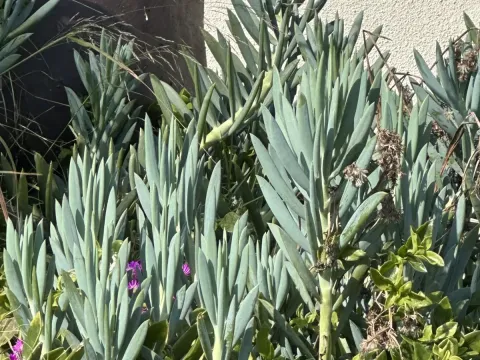
The genus Curio belongs to the Asteraceae family. These are succulent perennial plants that were previously classified as part of the genus Senecio. They represent shrubby or herbaceous forms with characteristic fleshy leaves adapted to long periods of drought.
What the section contains
 Candle Plant
Curio articulatus (L. f.) P. V. Heath
Candle Plant
Curio articulatus (L. f.) P. V. Heath
 Curio articulatus x Curio rowleyanus hybrid
hybrids between Curio articulatus (L. f.) P. V. Heath and Curio rowleyanus (H. Jacobsen) P. V. Heath
Curio articulatus x Curio rowleyanus hybrid
hybrids between Curio articulatus (L. f.) P. V. Heath and Curio rowleyanus (H. Jacobsen) P. V. Heath
 Curio ficoides
 (L.) P. V. Heath
Curio ficoides
Curio ficoides (L.) P. V. Heath
 Curio herreanus
 (Dinter) P. V. Heath
Curio herreanus
Curio herreanus (Dinter) P. V. Heath
 Curio talinoides
 (DC.) P. V. Heath
Curio talinoides
Curio talinoides (DC.) P. V. Heath
 String of pearls
Curio rowleyanus (H. Jacobsen) P. V. Heath
String of pearls
Curio rowleyanus (H. Jacobsen) P. V. Heath
Curio
The origin of most Curio species is associated with the arid regions of Southern Africa. In their natural environment, they grow on rocky soils, well-drained sites, and slopes where rainfall is limited. In cultivation, these plants are adapted for greenhouse conditions or as houseplants in temperate climates.
For successful development, the crop requires well-lit locations, preferably with direct sunlight during the morning hours. The plant is extremely sensitive to excessive soil moisture, making it critical to use a substrate with a high proportion of draining materials such as sand, perlite, or fine expanded clay.
The temperature regime should be moderately warm in summer (20–25°C) and cool in winter (not lower than 10–12°C). Curio cannot tolerate freezing temperatures, so when grown outdoors, they must be moved indoors before the first frosts.
Watering must be strictly measured: it should be performed only after the soil ball has completely dried out. During the winter period, the plants enter a stage of dormancy, so watering is minimized to prevent root rot.
The primary threat to members of the Curio genus is fungal diseases caused by poor agronomic practices, specifically substrate overwatering. Root and stem rots quickly affect succulent tissues, often leading to the death of the entire plant if intervention is not timely.
Among pests, mealybugs are the most common, settling in leaf axils and sucking sap, which weakens the plant's immunity. For control, it is recommended to use systemic insecticides or wipe the affected areas with an alcohol solution.
The plant may also be attacked by spider mites under conditions of excessively dry and stagnant air. Prevention consists of maintaining optimal ventilation in the growing area.
When affected by fungi (such as powdery mildew), fungicides based on copper or specific preparations for succulent crops are applied. It is important to ensure rapid drying of the substrate after any application of liquid fertilizers or treatments.
To maintain the health of the culture, it is necessary to regularly inspect the lower leaves for signs of deformation or discoloration. Any patch of atypical color may indicate a disturbance in the watering regime or the onset of an infectious process.