
String of pearls
Curio rowleyanus (H. Jacobsen) P. V. Heath
Description
Growing requirements
String of pearls (Curio rowleyanus) is a perennial succulent belonging to the Asteraceae family. Native to the arid regions of Southwest Africa, it has evolved into a unique trailing plant adapted to desert environments.
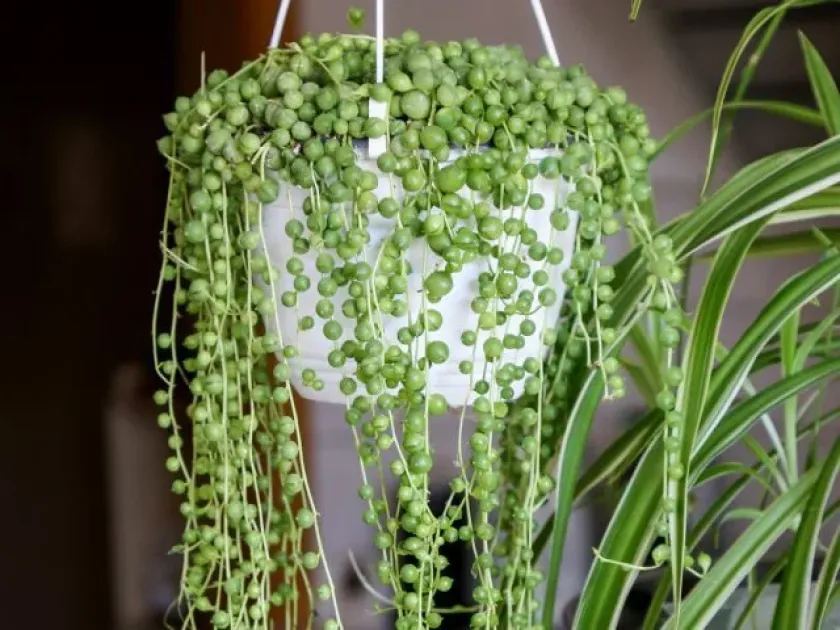
The plant is distinct for its spherical, pea-like leaves, which are actually a specialized evolutionary adaptation to maximize water storage and minimize surface area for evaporation under harsh sunlight.
Cultivation requires a location with bright, indirect light. While it can handle some early morning sun, intense afternoon rays should be avoided to prevent scorching the delicate foliage.
A well-draining soil mix is critical for this species. A blend consisting of cactus potting soil, coarse sand, and perlite provides the necessary aeration to prevent root suffocation.
Regarding water requirements, the soak-and-dry method is the gold standard. Allow the soil to dry out completely throughout the container before providing the next watering session.
Main diseases and pests
The primary threat to the health of the plant is root rot induced by overwatering. If the roots remain wet for too long, they will decay rapidly, leading to the collapse of the entire vine structure.
Pest issues usually involve mealybugs, which hide in the crevices between the leaf beads. These pests are difficult to remove manually and often require systemic insecticides for total eradication.
Spider mites are another common challenge, especially in low-humidity environments. Regularly misting the surrounding area or providing proper airflow can help mitigate the risk of mite infestations.
Fungal pathogens can occasionally affect the plant if humidity levels are consistently too high. Improving air circulation around the plant is the most effective cultural method to prevent fungal development.
Leaf drop is a common sign of stress. Whether caused by sudden temperature shifts, overwatering, or extreme underwatering, it indicates that the plant is struggling with its current environment and needs immediate adjustment of its care routine.