
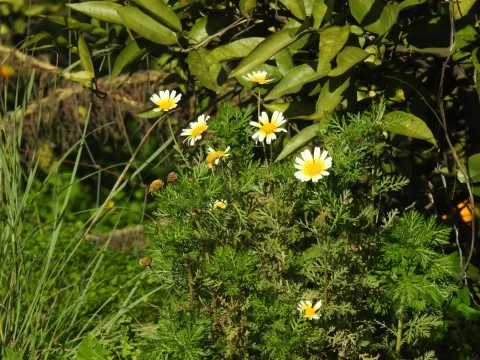
Crown Daisy
Glebionis
Crown Daisy is a cool-season crop, so seeds should be sown in open ground early in the spring, once soil temperatures reach 8–10°C.
What the section contains

Crown Daisy
For an early harvest, winter sowing in late October is possible, allowing for the first crop to be gathered by early summer.
In regions with long daylight hours, the plant quickly transitions to the flowering stage, so successive sowing every 14–20 days is recommended.
Seeds should be planted at a depth of 1–1.5 cm, ensuring consistent soil moisture until mass germination occurs to guarantee uniform growth.
An optimal planting layout involves maintaining a distance of 20–30 cm between rows to ensure sufficient nutrition and airflow for the plants.
This crop prefers well-lit areas but can tolerate partial shade, making it suitable for intensive gardening or intercropping systems.
The soil should be fertile, with a neutral or slightly acidic pH, and rich in organic matter to support vigorous leafy foliage development.
Crown Daisy requires regular watering; in drought conditions, the leaves become tough, lose their flavor, and the plant bolts prematurely.
The plant belongs to the Asteraceae family and originates from East Asia, where it is traditionally valued as an important leafy vegetable.
The ideal temperature for optimal growth ranges between 15–22°C; extreme temperature fluctuations and excessive heat negatively affect market quality.
The average yield of Crown Daisy greens ranges from 1.5 to 3 kg per square meter, depending on sowing density and agronomic management.
The growth rate of the greens depends on timely nitrogen fertilization, which stimulates the development of vegetative biomass before budding.
By consuming young shoots and leaves, the total harvested biomass can be significantly higher than when collecting only the tops of the plant.
Timely thinning of seedlings is a critical factor, as overcrowded plants produce significantly less marketable volume and quality produce.
Commercial and home use includes fresh greens in salads, soups, and stir-fry dishes, as well as the use of flowers for culinary and decorative purposes.
The primary pests affecting Crown Daisy are aphids and spider mites, which can quickly colonize tender young leaves during hot, dry weather.
In conditions of high humidity and poor air circulation, the crop is susceptible to powdery mildew, which appears as a white coating on the leaves.
To prevent disease spread, it is essential to strictly follow crop rotation and avoid overcrowding, ensuring proper aeration throughout the plot.
Against insect pests, it is preferable to use organic biopesticides or natural extracts, as the greens are typically ready for harvest shortly after treatment.
Root rot may occur due to waterlogging, making the provision of efficient drainage and moderate, consistent watering key preventive measures.
Harvesting begins when plants reach 15–20 cm in height, by cutting the tender tops and leaves before any flower buds begin to form.
To extend the harvesting period, partial cutting methods can be employed, allowing the plant to develop lateral shoots for a second harvest of greens.
Harvesting is best performed in the early morning hours when plant tissues are fully turgid, which improves their longevity and shelf life after cutting.
Cut greens should be stored in a cool place away from direct sunlight to prevent rapid wilting and the loss of essential market quality.
If the purpose of cultivation is flower production, harvest should occur during the semi-open inflorescence phase to maximize vase life.