
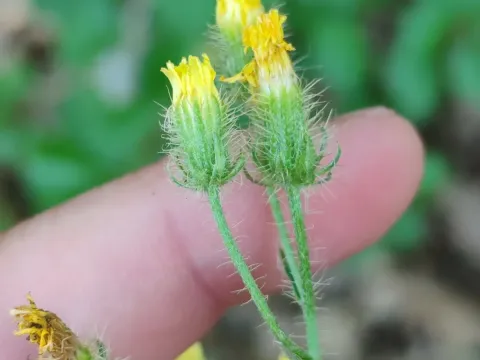
Bristly hawksbeard
Crepis setosa
Bristly hawksbeard (Crepis setosa) is an annual herbaceous plant belonging to the Asteraceae family. It is recognized as a significant weed species commonly found in agricultural landscapes, including cereal fields and fallow lands.
What the section contains
Bristly hawksbeard
Botanically, the plant features a branched stem covered with distinct stiff bristles. The basal leaves form a rosette, while the stem leaves are sessile and lanceolate, characteristic of the genus Crepis.
Originating from the Mediterranean region, the species has successfully colonized various environments across Europe and other temperate regions, showing high adaptability to diverse landscapes.
The plant thrives in well-lit environments and shows no strict preference for soil types, although it performs best in soils with adequate moisture and moderate fertility levels.
Due to its biological efficiency, it competes aggressively with crops for essential resources such as solar radiation, water, and soil minerals, often leading to yield reduction in untreated fields.
As a member of the Asteraceae family, Crepis setosa can serve as an alternative host for several plant pathogens, including those responsible for powdery mildew and rust diseases.
In terms of pests, various sap-sucking insects and specialized beetles utilize the plant as a habitat, which can complicate integrated pest management strategies in adjacent crops.
The primary threat to farming operations is the rapid spread of the species through wind-dispersed seeds, which can quickly colonize large areas if not managed during the early growth stages.
Chemical control is often achieved by applying selective herbicides during the rosette stage, which is the period when the weed is most susceptible to active ingredients.
Mechanical cultivation remains an essential practice, particularly in early spring, to disrupt the root system and eliminate the weed before it can establish its taproot and mature.