
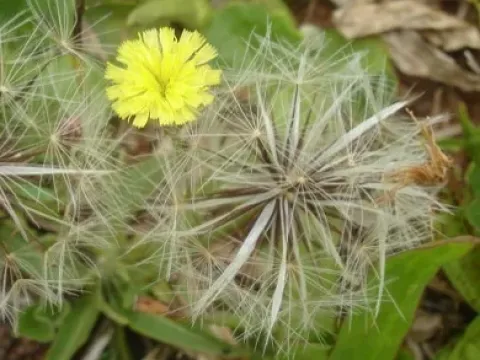
Brazilian catsear
Hypochaeris brasiliensis
Brazilian catsear, belonging to the Asteraceae family, is a perennial plant often studied for its resilience and potential as a forage or cover crop.
What the section contains
Brazilian catsear
The sowing process typically begins in early spring when soil temperatures reach a consistent level of 10 to 12 degrees Celsius, facilitating rapid seed germination.
For optimal establishment, seeds should be sown at a shallow depth of approximately 1-2 cm, ensuring they remain in contact with moist, nutrient-rich soil particles.
Precise seed spacing is vital for the development of individual plants, as excessive overcrowding can lead to diminished biomass production and stunted growth.
Proper field preparation, including light cultivation to reduce competitive weeds before seeding, is essential for ensuring that the crop establishes itself successfully.
The plant thrives in well-drained, sandy loam soils that prevent waterlogging, which is a key factor in avoiding root degradation in this species.
It prefers sunny, open environments, as its growth rates and overall vigor are significantly tied to the intensity and duration of solar radiation.
While the species exhibits moderate drought tolerance, adequate moisture during the early vegetative stage is critical for developing a robust root system.
Fertilization regimes should focus on providing a balanced supply of nitrogen and phosphorus to support both leaf development and potential seed maturation.
The crop is highly adaptable to various soil pH levels, although it tends to show its best performance in neutral conditions where nutrient uptake is most efficient.
Primary threats to crop health include root-related fungal pathogens that may occur if irrigation management is poorly controlled during stagnant weather.
Foliar pests, particularly aphid populations, can cause significant damage to the leaf tissue, necessitating regular field scouting to monitor pest density.
Mildew and other moisture-related fungi pose a risk when environmental conditions lead to high humidity and restricted air circulation around the plants.
Effective management includes implementing a well-planned crop rotation strategy to limit the buildup of host-specific pathogens in the soil.
If weed infestation is severe in the early stages, mechanical control measures are usually more effective than chemical treatments for this specific perennial.