
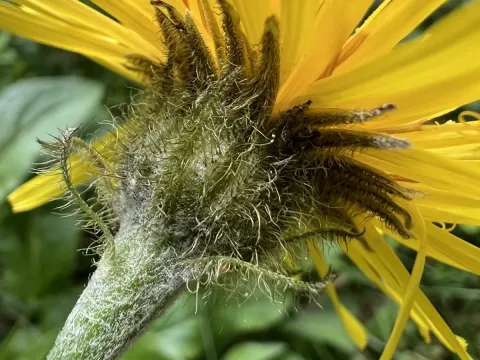
Crepis pontana
Crepis pontana
Crepis pontana is a perennial herbaceous plant belonging to the Asteraceae family. In agricultural settings, it is often utilized as a promising forage crop for enhancing the botanical composition of natural pastures and hayfields.
What the section contains
Crepis pontana
In temperate climates, seeding should be carried out in early spring or during the autumn season. The optimal sowing depth for these small seeds is 1–2 centimeters, which ensures uniform germination and establishment.
When incorporating it into forage mixtures, it is sown in rows spaced 15–20 cm apart. The crop exhibits high germination energy, allowing it to quickly establish itself within the sward and effectively compete with weeds.
Successful sowing requires thorough soil preparation to create a fine-textured and sufficiently firm seedbed. Good soil-to-seed contact is critical, as the small seeds are highly sensitive to moisture levels in the topsoil.
A key biological feature is the plant's ability to form a robust basal leaf rosette in its first year. This structural adaptation allows it to survive the winter and initiate rapid growth in the second vegetation season.
Crepis pontana shows high adaptability to various soil types, although it performs best on fertile loamy and sandy-loam soils with a neutral or slightly acidic pH level.
The crop prefers sunny locations, as it is a light-demanding species. Excessive shading can significantly retard the development of the basal rosette, leading to a reduction in total biomass production.
The optimal temperature range for active growth is 18–22 degrees Celsius. The plant possesses excellent cold resistance, making it suitable for cultivation in northern and mountainous regions.
While its water requirements are moderate, the plant may experience slowed growth during prolonged droughts. Irrigation during these periods can significantly enhance agricultural productivity.
The plant responds well to mineral fertilizers, particularly nitrogen-phosphorus complexes. Nitrogen, in particular, promotes intensive development of the green mass required for hay or grazing purposes.
The biomass yield of Crepis pontana is directly dependent on agronomic management intensity and regional climatic conditions. Under favorable conditions, the plant can produce multiple cuts per season.
Agricultural usage is primarily focused on providing nutritious forage for livestock. The foliage contains a balanced complex of vitamins and minerals essential for a healthy diet in ruminants.
Maximum biomass yield is achieved during the budding phase and the onset of flowering, before the stems become overly fibrous. This period ensures the best ratio of protein and fiber for high-quality silage or hay.
Productivity levels typically range from 15 to 25 tons of green mass per hectare under intensive management. The plant is capable of rapid regrowth after the harvesting process.
Including Crepis pontana in cultivated pastures enhances the overall carrying capacity of the land. Due to its longevity, the crop can persist in a sward for 5–7 years with proper maintenance.
Like many members of the Asteraceae family, Crepis pontana can be susceptible to powdery mildew under high humidity and poor aeration. Maintaining appropriate planting density is a vital preventative measure.
Aphids pose the most significant threat to the crop, as they feed on the sap of young leaves and shoots, leading to leaf deformation and stunted growth.
In some seasons, the root system may suffer damage from wireworms, especially if crop rotation protocols are neglected or if the plant follows perennial grass stands.
Effective disease prevention includes timely mowing, the use of certified seed material, and the consistent implementation of weed control measures.
Chemical protection is only justified during mass outbreaks of pests. It is strongly recommended to prioritize biological pest control methods to maintain the organic quality of the forage.
Harvesting for fodder is best performed during the mass flowering phase, when the concentration of essential nutrients in the aerial parts of the plant reaches its peak.
For hay production, mowers are used followed by windrowing and drying. Careful management is required to avoid over-drying, which can lead to the loss of nutritious leaves.
When intended for silage, early mowing is recommended. This produces succulent forage with higher sugar content, which is vital for the fermentation processes required for high-quality preservation.
Seed harvesting should occur when the majority of inflorescences begin to turn brown. It is critical to harvest in dry weather to prevent the development of mold on the gathered seeds.
After mowing, a stubble height of at least 5–7 cm should be maintained to ensure proper regeneration and plant preparation for the following winter period.