
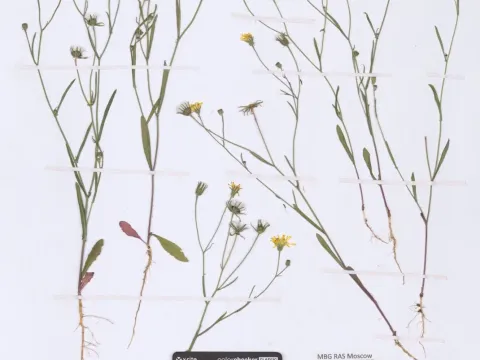
Crepis ramosissima
Crepis ramosissima
Crepis ramosissima is a member of the Asteraceae family. It is a herbaceous plant characterized by its branched stem structure, which makes it a distinctive species in its natural habitat.
What the section contains
Crepis ramosissima
The plant originates from the temperate regions of Eurasia. It is well-adapted to steppe ecosystems and thrives in environments where soil moisture can be limited during the summer season.
The root system of this species is deep and robust, allowing it to extract water and nutrients effectively from varied soil types, including sandy and silty loams.
In terms of climatic requirements, Crepis ramosissima prefers open areas with high solar radiation. It exhibits significant tolerance to fluctuations in temperature and rainfall patterns.
The botanical structure consists of a basal rosette of leaves and a flowering stalk that branches out, producing small yellow flowers which are typical for the Crepis genus.
The sowing season for this crop generally starts in early spring. It is essential to ensure that the soil is sufficiently loose to allow for rapid seedling emergence.
Shallow planting is critical for the success of this crop. Seeds should be placed at a depth of no more than 1.5 cm to ensure they receive enough light and moisture.
The use of a precise seeder helps to maintain optimal density, which is crucial for reducing competition between individual plants within the same row.
Soil preparation should involve thorough harrowing to remove existing weed cover, providing a clean seedbed for the germination of Crepis seeds.
Post-sowing maintenance includes soil consolidation to improve moisture capillary action, which is vital in regions with arid spring conditions.
The main threats to the healthy development of this crop include fungal infections that target the leaf tissues, particularly when humidity levels remain high for extended periods.
Aphids represent the most significant pest concern, as they colonize the flowering stems and can lead to a decrease in seed quality and vegetative volume.
Crop rotation is recommended as the primary management strategy to break the life cycle of soil-borne pathogens that might affect the Asteraceae family.
Mechanical weed control is effective during the early stages of growth, ensuring that the crop receives sufficient access to sunlight and soil nutrients.
Integrated pest management protocols should be utilized if threshold levels of infestation are observed, focusing on minimally toxic substances to preserve beneficial insects.