
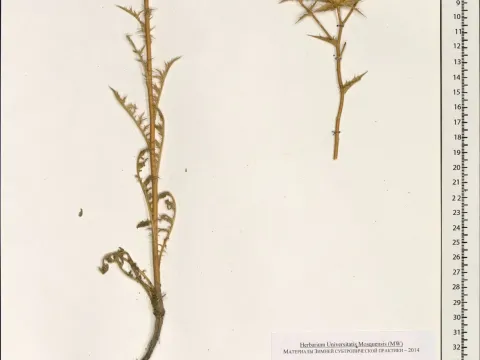
Persian safflower
Carthamus persicus
Persian safflower is a highly drought-tolerant plant, making it an excellent choice for early spring planting. Sowing usually begins as soon as the soil reaches a temperature of 5 to 8 degrees Celsius at seeding depth.
What the section contains
Persian safflower
Ensuring adequate moisture retention in the soil before sowing is crucial. Early planting allows the plant to develop a deep taproot system, which is essential for surviving the hot and dry summer months often encountered in its growing regions.
The recommended seeding depth is 3 to 5 centimeters. On lighter, sandy soils, it is beneficial to sow slightly deeper to reach consistent soil moisture levels, which promotes uniform germination across the field.
Optimal plant population varies depending on the region and harvesting method, typically ranging from 150,000 to 300,000 plants per hectare. Achieving the right density is key to maximizing yield potential.
Maintaining proper row spacing and uniform plant distribution reduces competition for light and nutrients, ultimately leading to more robust plants and higher overall seed quality.
As a member of the Asteraceae family, Persian safflower is uniquely adapted to arid and semi-arid environments. It thrives in conditions where other traditional oilseed crops may fail due to limited water availability.
The crop prefers well-drained soils, including chernozems and chestnut soils. It is critical to avoid waterlogged conditions, as the plant is highly susceptible to root rot and other fungal issues when exposed to stagnant water.
Safflower is highly adaptable to a wide range of temperatures. It shows good tolerance to light frost during the seedling stage, while being remarkably heat-resistant during the crucial flowering and seed-filling phases.
High solar radiation is required for optimal photosynthesis. The plant is a long-day species and does not perform well in shaded areas, so selecting open, sunny fields is mandatory for successful cultivation.
Weed management is a critical factor in the early stages of growth. Since safflower grows relatively slowly initially, keeping the field free of weeds through mechanical or chemical means ensures the crop can establish itself without competition.
The yield of Persian safflower is highly dependent on moisture levels during the period from budding to full flowering. Sufficient water during these critical phenological stages is the primary determinant of a high-quality harvest.
Under optimal agronomic management, farmers can expect yields ranging from 0.8 to 1.5 tonnes per hectare. In regions where supplementary irrigation is possible, these figures can be significantly improved.
Oil content is a key economic metric for this crop, typically ranging from 25 to 35 percent. This oil is highly valued in both food production and industrial applications, including cosmetics and technical lubricants.
The number of seed-bearing heads per plant is directly influenced by nutritional management and planting density. In well-tended fields, a single plant can produce up to 20 productive heads.
It is important to manage nitrogen applications carefully, as excessive fertilizer can lead to lodging or prioritize vegetative growth at the expense of seed production, ultimately lowering the final yield.
Rust is one of the most common and damaging fungal diseases affecting Persian safflower. It targets the foliage, significantly reducing the plant's photosynthetic capacity and leading to lower yields if not controlled.
Fusarium wilt is a major soil-borne pathogen, especially in fields where crop rotation is neglected. It disrupts the plant's vascular system, causing rapid wilting and death, which can create significant bare patches in the field.
The safflower fly is a primary pest. Its larvae feed inside the seed heads, destroying the seeds and drastically reducing both the quantity and market quality of the harvest, necessitating timely insecticide intervention.
Aphid infestations are also common, particularly during dry weather. They suck the sap from tender shoots, weakening the plant and acting as vectors for various viral diseases, which further complicates crop health.
To minimize these threats, a long-term crop rotation strategy is essential. Planting safflower in the same field only once every 4 to 5 years helps break the life cycles of most soil-borne pathogens and pests.
Harvesting should be timed precisely to coincide with full maturity. The heads should be completely dry and brown, and seed moisture should be low to ensure proper storage stability and quality.
Direct combining is the standard method for harvesting safflower. Modern machinery equipped with specialized header attachments helps reduce shatter loss, which is critical for minimizing yield losses during the harvesting process.
Once harvested, the seeds should be cleaned and, if necessary, dried to a moisture content of 10 percent or less. Proper post-harvest conditioning prevents heating and molding during storage.
Because the stems become very tough and dry at harvest, machine maintenance is important. Additionally, operators should take precautions against the plant's natural spines, which can be irritating during field activities.
Investing in high-quality cleaning equipment allows producers to improve the commercial value of their seed lot by removing chaff and damaged seeds, meeting the strict requirements of oil extraction facilities.