
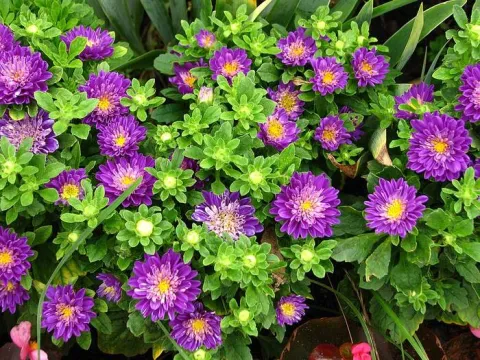
China aster
Callistephus
Callistephus chinensis, commonly known as the China aster, is an annual flowering plant typically grown from seeds. Successful cultivation begins with high-quality seeds that require careful handling to ensure uniform germination.
What the section contains
China aster
For professional production, seeds are sown in greenhouse trays during early spring. A controlled temperature of 18 to 20 degrees Celsius is essential for optimal emergence within 7 to 14 days.
Transplanting into the field is performed once the danger of frost has passed and the soil has reached sufficient warmth. Proper spacing is vital to ensure adequate air circulation around the plants.
Direct seeding in the field is an alternative for warmer regions. However, this requires precise depth control and consistent moisture management to ensure successful seedling establishment.
The hardening-off process is a critical stage for greenhouse-grown transplants. Gradually exposing seedlings to external conditions over a week improves their survival rate after transplantation.
China asters thrive in full sun, which is necessary for compact growth and vibrant flower production. Locations with partial shade may result in weaker stems and reduced blossom quality.
The ideal soil for this species is well-drained, fertile, and sandy loam with a neutral pH level. Improving heavy clay soils with organic amendments is recommended to enhance root development.
Watering frequency depends on local climate conditions, but the goal is to keep the soil consistently moist without waterlogging. Irrigation systems should be designed to keep foliage as dry as possible.
Nutrient management is based on the plant's growth stages. A balanced fertilizer applied early in the season is followed by a higher potassium concentration as the plant approaches the budding stage.
Maintaining a weed-free field is essential for optimal plant vigor. Manual weeding or shallow mechanical cultivation prevents competition for water and vital soil nutrients.
Fusarium wilt is arguably the most devastating fungal disease for Callistephus. It causes sudden wilting and death, and because the pathogen persists in the soil, long crop rotations are mandatory.
Powdery mildew represents a significant challenge during periods of high humidity and poor air circulation. It appears as a white, powdery dusting on leaves, which can severely stunt growth.
Insect pests, including aphids and tarnished plant bugs, are primary concerns for commercial growers. Beyond direct feeding damage, they act as vectors for viral diseases such as aster yellows.
Root-knot nematodes can cause stunted plant growth and overall decline. Soil solarization or pre-plant nematicide treatments are often used in high-intensity production environments.
Integrated Pest Management (IPM) strategies, including monitoring and biological control, are highly recommended to minimize the reliance on chemical pesticides while maintaining product quality.