
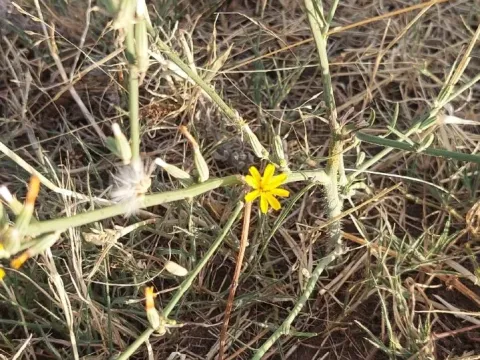
Chondrilla acantholepis
Chondrilla acantholepis
Chondrilla acantholepis is a perennial herbaceous plant belonging to the Asteraceae family. It is well-adapted to arid environments and characterized by its distinct spiny-scaled involucres that give the plant its specific botanical identity.
What the section contains
Chondrilla acantholepis
The plant undergoes a generative cycle where seeds are disseminated, typically by wind, to colonize open, sun-exposed areas. Germination usually occurs in early spring when moisture levels in the soil allow for the initial establishment of the seedling.
During the first phase of growth, the plant forms a robust rosette of basal leaves. This structure allows the plant to accumulate vital resources before developing its characteristic flowering stems later in the season.
The development of a deep taproot is a crucial stage in the plant's life cycle. This organ serves not only for anchorage but also as a storage site for carbohydrates, ensuring the plant's survival during unfavorable weather conditions.
In agricultural systems, the spread of this species is managed through strict field monitoring. Since the plant can regenerate from root fragments, mechanical clearing must be thorough to prevent rapid regrowth in subsequent cycles.
The species is a classic xerophyte, showing remarkable tolerance to drought. It thrives in regions with limited annual precipitation, where it competes effectively for sparse soil moisture against other vegetation.
Soil preferences lean towards light, well-drained textures such as sand, sandy loam, or gravelly substrates. High drainage capacity is essential to prevent root rot, although the plant is generally highly resistant to various soil stresses.
Chondrilla acantholepis is strictly photophilous, requiring full sunlight to complete its development. Any form of shading from surrounding vegetation or taller crops will significantly inhibit its growth and flowering success.
The plant demonstrates extreme thermal adaptability, surviving temperatures that fluctuate significantly throughout the day. It remains physiologically active during periods of intense heat when moisture-sensitive plants would typically wilt.
Agronomic management involves regular soil cultivation and deep tilling. By severing the taproot at significant depths, farmers can effectively disrupt the plant's ability to sprout new shoots during the growing season.
Chondrilla acantholepis possesses a high degree of natural resistance to most agricultural pathogens. It rarely suffers from significant damage caused by common fungal, bacterial, or viral diseases found in cropland.
While the plant may act as a temporary host for certain aphids, it does not typically attract large-scale pest infestations. The presence of secondary metabolites in the plant tissues often serves as a deterrent to various herbivores.
In cases of extremely high humidity, powdery mildew may appear on the foliage. However, this rarely affects the overall health of the plant or its capacity to spread, given the arid climate where it usually resides.
Chemical control remains an option for intensive management, particularly during the rosette growth phase. Using systemic herbicides ensures that the chemical reaches the root system, which is the key to preventing long-term infestation.
Preventative cultural practices, such as crop rotation and maintaining high crop density, are the most effective ways to limit the encroachment of this species into cultivated land. Competition from denser crops naturally suppresses its expansion.