
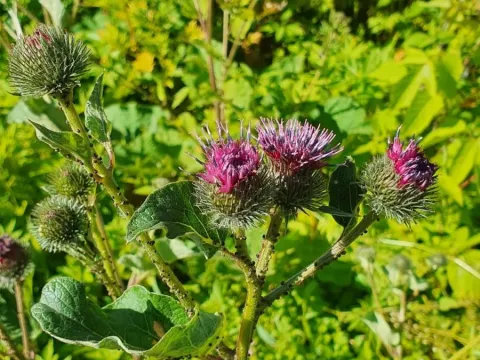
Arctium ambiguum
Arctium ambiguum
Arctium ambiguum, a member of the Asteraceae family, is a biennial plant known for its robust taproot system. In its first year, it focuses on forming a large, thick leaf rosette, storing nutrients in its fleshy root, which is the primary part harvested for commercial use.
What the section contains
Arctium ambiguum
Sowing should take place in early spring once the soil temperature is consistently above 8–10 degrees Celsius. Successful establishment requires a firm, moist seedbed to ensure rapid germination and uniform growth across the field.
Planting in rows spaced 45 to 60 centimeters apart is recommended to facilitate mechanical cultivation and weed control. Seeds should be placed at a depth of 2–3 centimeters, covered with fine, well-aerated soil.
Seedlings typically emerge within 12–18 days, depending on environmental conditions. Early development is relatively slow, making the initial weed management phase critical for establishing a productive crop canopy.
The second year of growth triggers the development of a tall, branched flowering stalk. While the plant is typically harvested before this stage for industrial use, the biennial cycle is fundamental to understanding its developmental requirements and physiological needs.
This crop thrives in fertile, well-drained, and deep loamy soils. Good soil structure is essential for the unhindered expansion of the taproot, which is the most valuable part of the plant for the pharmaceutical and food industries.
Arctium ambiguum is a sun-loving plant that prefers open areas with high exposure to sunlight. Adequate light levels are directly correlated with higher biomass accumulation in the roots, making site selection a priority for growers.
While the plant exhibits moderate drought tolerance, consistent moisture during the early vegetative stages promotes vigorous growth. Waterlogging, however, must be avoided at all costs to prevent root decay and secondary fungal infections.
Fertilization should prioritize phosphorus and potassium to support root development, rather than excessive nitrogen, which can lead to excessive leaf growth at the expense of root quality. Soil pH should ideally be in the neutral to slightly alkaline range.
Maintaining proper plant spacing is vital. Overcrowded fields result in smaller, stunted roots that do not meet commercial grading standards, emphasizing the need for precision during the thinning process in the early weeks of growth.
The economic yield of Arctium ambiguum is derived from its fleshy roots, which are rich in inulin, essential oils, and tannins. Average yields range from 15 to 25 metric tons per hectare, depending on soil quality and agricultural care.
Harvest timing is a key factor in maximizing the content of biologically active compounds. Industrial processors typically seek roots harvested at the end of the first growing season when the concentration of carbohydrates is at its peak.
The post-harvest process involves thorough washing to remove soil and debris, followed by drying. Controlled drying at temperatures not exceeding 50 degrees Celsius is necessary to preserve the plant's medicinal and nutritional integrity.
Yield stability depends on adherence to a strict crop rotation schedule. Growing the crop in the same soil repeatedly increases the risk of soil-borne pathogens, which can severely impact the quality and quantity of the final harvest.
Efficient processing operations can achieve a dry matter conversion rate of approximately 25–30 percent. Quality management from the field to the storage facility ensures a premium product that meets international safety and quality standards.
Powdery mildew is a common threat, manifesting as a white fungal layer on the leaves, which reduces photosynthetic efficiency. Timely application of approved fungicides or integrated pest management strategies is necessary to control the spread.
Pests like the burdock moth and various aphid species can cause significant damage to the plant's foliage. Monitoring programs should be in place to detect early signs of infestation and prevent widespread damage.
Root rot is the most serious threat, usually triggered by poor drainage or excessive soil moisture. Proper drainage management and the use of healthy, disease-free land are the best preventative measures against this condition.
Weeds are the primary competitor in the early growth phase. If left uncontrolled, they can suppress the growth of the young burdock plants, leading to significant yield losses. Mechanical hoeing or targeted herbicide use are standard industry solutions.
Effective crop protection relies on regular scouting and biological monitoring. By identifying issues at the onset, growers can maintain healthy stands and ensure the consistency of the harvest required for medical applications.
Harvesting Arctium ambiguum is a highly intensive process because the taproot can reach significant depths. Specialized digging equipment, such as deep-trench potato lifters, is essential to minimize root damage during extraction.
Timing the harvest for autumn requires monitoring soil moisture; if the soil is too dry or too wet, it becomes difficult to extract the roots without breakage, which significantly impacts the marketability of the product.
Spring harvesting must be completed quickly before the plant uses its stored nutrients to initiate the second-year growth phase. Any delay during this period leads to a rapid decline in the medicinal quality of the harvested root.
After extraction, roots must be sorted immediately to remove damaged or diseased material. Sorting ensures that only the highest quality roots proceed to the washing and drying stages, maintaining the value of the final shipment.
Final handling requires careful cleaning to ensure no soil remains in the fibrous parts of the root, as impurities can lead to contamination during storage and processing. Professional drying infrastructure is the final step in securing a high-quality product.