
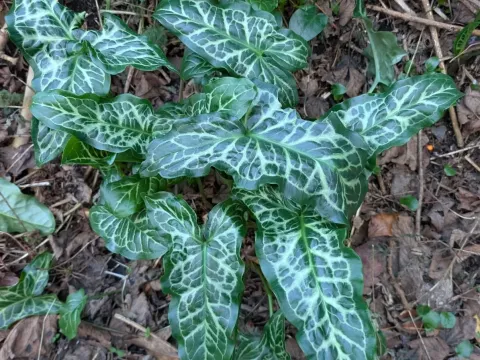
Italian arum
Arum italicum
Italian arum (Arum italicum) belongs to the Araceae family. This perennial tuberous plant originates from the Mediterranean region and is highly valued for its striking architectural foliage.
What the section contains
Italian arum
The plant thrives in partial shade or deep shade environments. It prefers fertile, humus-rich, and well-drained soils, as poor drainage is the primary cause of tuber rot during the dormant or wet season.
Botanically, it is unique for its winter-growing cycle, where leaves emerge in autumn and persist throughout the winter months. In late spring, it produces a spathe-covered inflorescence followed by red berries.
Proper site preparation is essential; the soil should be kept consistently moist but never waterlogged. Incorporating organic matter such as leaf mold or compost is recommended to mimic its natural woodland habitat.
In terms of agricultural use, the Italian arum is primarily an ornamental crop used in landscape architecture to provide year-round interest in shaded areas where other plants might fail.
Slugs and snails are the most significant pests for Italian arum. They are particularly active during the spring growth phase and can quickly defoliate young plants if left uncontrolled.
Root rot is the most common pathology, usually triggered by excessive moisture or compacted soil. It is vital to ensure proper aeration and drainage to maintain the health of the subterranean tubers.
Leaf spot diseases, caused by various fungal pathogens, may occur during periods of prolonged humidity. Good garden hygiene, such as removing affected foliage, helps prevent the spread of infections.
Viral infections can occasionally lead to mosaic patterns on the leaves and stunted growth. As there is no cure for such viruses, managing aphid populations, which act as vectors, is the main control strategy.
All parts of the plant contain calcium oxalate crystals, which can cause severe skin irritation. Protective gloves should always be worn when planting, dividing, or pruning the Italian arum.