
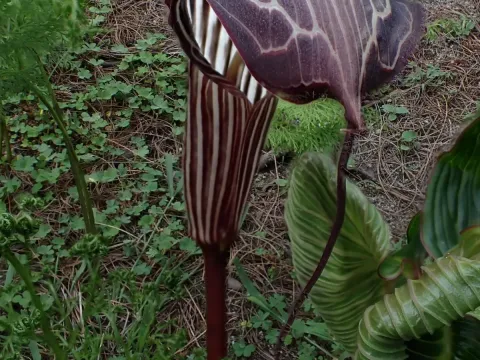
Ribbed cobra lily
Arisaema costatum
Planting the tubers of the ribbed cobra lily (Arisaema costatum) should be done in early spring once the soil has sufficiently warmed up. Typically, this is around April or May, depending on the local climate and current weather conditions.
What the section contains
Ribbed cobra lily
The tubers should be planted at a depth of 10 to 15 centimeters. It is crucial to ensure that the planting hole has a layer of grit or sand at the bottom to provide efficient drainage, as standing water is detrimental to the plant's health and can lead to rapid decay.
Propagation via seeds is a viable but time-consuming process. Fresh seeds should be sown in a well-draining, loose substrate immediately after harvesting. They often require a period of cold stratification to germinate successfully during the subsequent spring season.
When starting from seed, maintaining consistent moisture in the growing medium is essential for development. However, excessive moisture must be avoided to prevent fungal issues such as damping-off, which can quickly wipe out young seedlings.
Selecting the right location is vital for success. Arisaema costatum thrives in partial to full shade. Direct, harsh sunlight should be avoided to prevent scorched leaves, so placement beneath trees or on the north side of structures is generally ideal.
Belonging to the family Araceae, the ribbed cobra lily is a native of the Himalayan forests, which dictates its specific environmental needs. The plant thrives in fertile, loose, humus-rich soil that maintains good aeration while retaining adequate moisture.
Regular watering is necessary throughout the growing season. The soil should remain consistently moist but never waterlogged. Since the plant is sensitive to anaerobic conditions, excellent drainage is the single most important factor in its cultivation.
Winter protection is necessary in temperate zones where frost is severe. A thick layer of mulch, such as leaf mold or bark, can provide sufficient insulation for the dormant tubers. In colder regions, some growers prefer to lift and store the tubers in a cool, dry place.
Fertilization should be handled with care. Incorporating compost or well-rotted manure into the soil during planting is usually sufficient. Over-fertilization, especially with nitrogen-heavy products, can lead to soft growth that is more susceptible to pests and diseases.
The plant prefers cool air and a humid environment. In regions experiencing hot summers, it is important to provide protection from drying winds and excessive heat, which can cause the foliage to wilt and the plant to enter dormancy prematurely.
The most significant threat to Arisaema costatum is tuber rot caused by various soil-borne fungi (Fusarium, Phytophthora). These pathogens flourish in compacted, waterlogged soils where the oxygen supply to the roots is restricted, leading to rapid tissue death.
Slugs and snails are major pests that feed on the emerging shoots and leaves. Protecting the plants during their early development stages is critical, as heavy damage can significantly weaken the tuber and reduce the likelihood of flowering in the following year.
Under less than ideal conditions, such as poor airflow or low humidity, spider mites can become an issue. Regular monitoring of the foliage and appropriate sanitation practices are generally enough to keep these pests under control without the need for heavy pesticide use.
Sanitation is a key aspect of disease management. Removing and destroying any infected plant material immediately helps to prevent the spread of pathogens. Furthermore, avoiding overcrowding ensures better airflow, which naturally reduces the pressure of fungal diseases.
For long-term health, ensuring that the planting site has not been used for other susceptible aroids is a good practice. Treating the tubers with a systemic fungicide prior to planting can also provide a protective barrier during the initial establishment phase.