
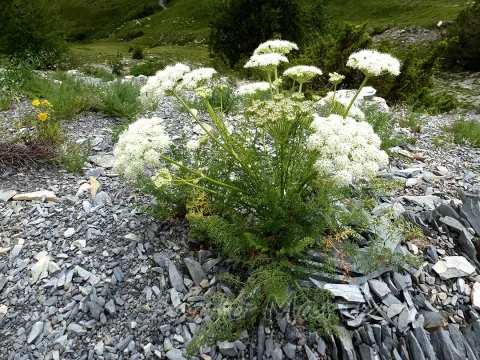
Ligusticum ferulaceum
Ligusticum ferulaceum
Ligusticum ferulaceum is a perennial herb belonging to the Apiaceae family. It is known for its slow initial growth rate and requires specific conditions for seed germination, often involving natural cold stratification.
What the section contains
Ligusticum ferulaceum
For best results, seeds should be sown in late autumn. This ensures the seeds experience the necessary winter temperatures to break dormancy. If spring sowing is required, artificial stratification for 4–6 weeks at low temperatures is essential.
Seeds are small and should be sown at a shallow depth of 1–2 cm. The soil must be kept moist during the germination period to ensure successful seedling establishment.
Spacing between rows should be maintained at 50–60 cm to allow the plant enough room to develop its large taproot, which is the primary part harvested for medicinal purposes.
In the first year, the plant focuses on developing its basal leaf rosette and root system. Full maturity and flowering typically occur from the second year onwards.
The plant thrives in well-drained, fertile loamy or sandy soil. It is highly sensitive to waterlogging, as stagnant water significantly increases the risk of root rot and other fungal diseases.
A sunny to lightly shaded location is ideal. While Ligusticum ferulaceum is hardy, it benefits from protection against strong winds that can damage the tall floral stalks during the reproductive phase.
Soil pH should be neutral, ideally between 6.5 and 7.5. Organic matter, such as well-rotted compost, should be incorporated into the soil before planting to provide long-term nutrient availability.
Regular weeding is critical, especially during the first growing season when the seedlings are small and unable to compete with faster-growing weeds.
Irrigation should be managed carefully to maintain consistent soil moisture during the active growing season, particularly in arid climates, while preventing the soil from becoming saturated.
The primary economic output of Ligusticum ferulaceum is its roots and rhizomes, which contain valuable essential oils and bioactive compounds. Harvesting is typically delayed until the third year to ensure maximum biomass and chemical potency.
Root yield varies depending on soil fertility, planting density, and local climatic conditions. Proper management ensures that the plant accumulates high concentrations of active ingredients.
Post-harvest processing involves cleaning, sorting, and drying the roots. Drying must be controlled at temperatures below 40°C to preserve the volatile components of the essential oils.
While the focus is on the roots, the seeds can also be collected for propagation purposes. However, root production remains the most lucrative aspect of cultivating this species.
Sustainable production practices, including proper crop rotation and soil management, allow for stable yields over several harvest cycles on the same farm site.
Fungal diseases are the primary threat, particularly root rot caused by poor soil drainage. Maintaining optimal soil moisture and aeration is the most effective preventative measure.
Powdery mildew may occur if planting density is too high, creating poor air circulation. Thinning plants and maintaining distance between rows helps mitigate this risk significantly.
Pests such as aphids and specific larvae affecting the Apiaceae family may target the foliage and flowers. Integrated pest management using biological controls is highly recommended over broad-spectrum pesticides.
Careful seed sourcing is vital to prevent the introduction of soil-borne nematodes or seed-borne pathogens that could compromise the entire crop's health.
Regular field scouting allows for the early detection of stress factors, enabling growers to intervene with precision before damage becomes irreversible.
Harvesting usually takes place in the autumn once the foliage begins to senesce. At this stage, the plant has translocated most of its nutrients into the root system.
Mechanical harvesters or plows are used to lift the roots from the soil. Care must be taken to minimize damage, as fresh wounds can serve as entry points for pathogens during the post-harvest period.
Roots should be washed thoroughly to remove dirt and debris. Quick cleaning prevents soil contamination from staining the surface of the roots or affecting their quality.
After cleaning, the roots are dried in forced-air dryers until they reach the desired moisture content, ensuring long-term shelf stability without losing potency.
Final storage should be in a cool, dry, and dark environment, using breathable packaging to keep the dried roots free from moisture and potential infestation.