
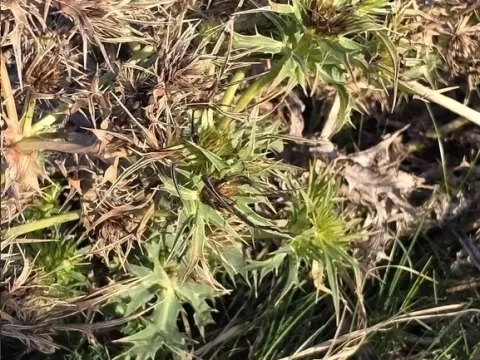
Eryngium
Eryngium L.
Sowing Eryngium L. usually requires a period of cold stratification, as the seeds often possess a natural dormancy that prevents germination in warm conditions.
What the section contains
 Alpine sea holly
Eryngium alpinum L.
Alpine sea holly
Eryngium alpinum L. x Eryngium planum L.
Alpine sea holly
Eryngium alpinum L.
Alpine sea holly
Eryngium alpinum L. x Eryngium planum L.
 Blue eryngo
Eryngium planum L.
Blue eryngo
Eryngium planum L.
 Eryngium carlinae
 F. Delaroche
Eryngium carlinae
Eryngium carlinae F. Delaroche
 Eryngium ebracteatum
 Lam.
Eryngium ebracteatum
Eryngium ebracteatum Lam.
 Eryngium pandanifolium
 Cham. & Schltdl.
Eryngium pandanifolium
Eryngium pandanifolium Cham. & Schltdl.
 Giant sea holly
Eryngium giganteum M. Bieb.
Giant sea holly
Eryngium giganteum M. Bieb.
 Rattlesnake Master
Eryngium yuccifolium Michx.
Rattlesnake Master
Eryngium yuccifolium Michx.
 Zabel's sea holly
Eryngium x zabelii Christ ex Bergmans
Zabel's sea holly
Eryngium x zabelii Christ ex Bergmans
Eryngium
For large-scale cultivation, seeds are best sown in late autumn to allow the winter cold to break the seed dormancy naturally before spring growth begins.
If sowing in spring, it is highly recommended to artificially stratify the seeds in a refrigerator for at least 30 to 40 days prior to planting.
The seeds should be covered with a thin layer of fine soil, as they require a certain amount of ambient light to successfully initiate germination.
Spacing is critical during the sowing process, with rows typically set at 40–50 cm apart to ensure adequate airflow and ease of mechanical weeding.
Belonging to the Apiaceae family, Eryngium is a hardy, drought-tolerant genus that thrives in full sun and well-drained, even sandy or stony soils.
The plants are particularly sensitive to waterlogged conditions, which can lead to rapid root rot and overall failure of the commercial crop.
They are well-adapted to poor soil fertility and do not require excessive amounts of nitrogen, which could cause overly soft and weak stem growth.
Eryngium is exceptionally frost-hardy and can withstand significant temperature drops, making it suitable for a wide range of temperate climates.
Good soil structure is preferred, but the plant's deep taproot allows it to access water reserves that are inaccessible to many other traditional crops.
The yield of Eryngium is largely based on the intended market, whether it is for pharmaceutical dried herb production or the floral decorative industry.
As a robust perennial, the crop can provide multiple harvests over several years, with yields increasing significantly as the root system matures.
Nectar production from Eryngium flowers makes it an excellent candidate for intercropping in areas where apiculture and herbal cultivation are combined.
Farmers can expect consistent yearly output once the plantation is established, provided that the soil drainage and sun exposure remain optimal.
Effective management of harvest timing ensures the highest concentration of phytochemicals, which is a key factor in the market price of the dry mass.
Root rot caused by Phytophthora species is the most significant threat, typically appearing after heavy rainfall or in low-lying, poorly drained areas.
Powdery mildew is a common foliage issue, especially in seasons with high humidity or when plant density prevents sufficient cross-ventilation.
Aphids can infest the succulent young flower buds, leading to stunted growth and reduced attractiveness of the harvestable stems.
Managing weed competition in the early growth stages is essential, as slow-growing seedlings can easily be suppressed by vigorous pasture weeds.
Integrated pest management strategies focusing on cultural practices, such as proper spacing, are generally sufficient to maintain healthy crop stands.
Harvesting for medicinal use occurs during the full bloom phase, using sharp mechanical sickles to cut the stems near the base of the plant.
When harvesting for the cut flower market, stems are cut when the flower heads have developed their characteristic blue or silvery metallic sheen.
Post-harvest, the stems must be dried quickly in a dark, airy environment to maintain the structural integrity and color of the floral bracts.
Seed harvesting requires careful timing; the seed heads should be clipped just as they turn brown to minimize loss due to natural shedding in the field.
Proper storage involves keeping the dried product in a moisture-free environment to prevent mold and to preserve the botanical quality for the market.