
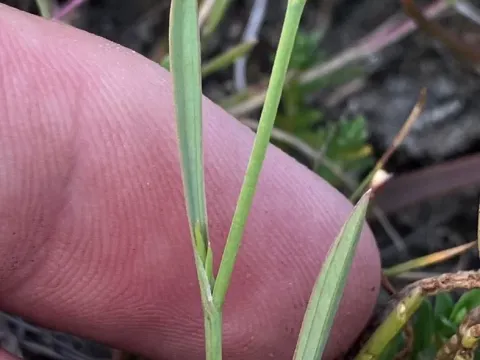
Slender hare's-ear
Bupleurum tenuissimum
Slender hare's-ear (Bupleurum tenuissimum) is an annual plant that typically propagates through seed dispersion in its natural habitats.
What the section contains
Slender hare's-ear
In agricultural settings, seeds are best sown in late autumn to ensure they undergo the necessary period of winter cold stratification for effective germination.
The seeds are relatively small, so they should be sown shallowly, ideally at a depth of no more than 1 to 2 centimeters to ensure consistent soil contact.
Proper field preparation is essential, as the seedlings are delicate and require a weed-free environment to establish their root systems during early spring.
Staggered sowing may be employed to extend the harvest window, although the plant's natural life cycle is primarily synchronized with late summer flowering.
Belonging to the Apiaceae family, Bupleurum tenuissimum is well-adapted to specific, often challenging environments, particularly saline soils and salt marshes.
This species is considered a halophyte, displaying high tolerance to salinity, which makes it a unique candidate for ecological restoration of degraded lands.
The plant thrives in full sun and requires open, unshaded conditions to reach its full development potential and produce healthy seeds.
It prefers well-drained soils, even those with high limestone content, and is capable of withstanding periodic moisture deficits due to a robust taproot.
While tolerant of saline conditions, it still requires adequate space between plants to allow for proper airflow and to mitigate the risks of fungal diseases.
The yield of Bupleurum tenuissimum is not typically measured in terms of bulk feed mass, as its primary value lies in its medicinal and chemical composition.
When cultivated for herbal production, the focus is on maximizing the accumulation of flavonoids and other secondary metabolites in the aerial biomass.
Optimal yields are achieved when the plants are harvested at the peak of their flowering phase, just before the seeds begin to reach maturity.
Seed production yields depend heavily on weather conditions during the maturation phase, as excessive wind or heat can cause significant seed shattering.
With correct site selection, particularly in saline-prone areas, the crop can provide a sustainable harvest of high-quality raw plant material.
Fungal pathogens such as powdery mildew and various rusts are the most frequent threats, especially when air circulation around the plants is poor.
Root rot remains a significant risk if the soil becomes waterlogged, which highlights the importance of choosing sites with naturally high drainage.
Insects like the umbellifer moth can cause severe damage to the reproductive structures, significantly impacting the overall reproductive success of the crop.
Competition from faster-growing weeds can choke the slender seedlings, making early-stage manual or mechanical weeding a vital part of the management plan.
- Powdery mildew
- Rust disease
- Umbellifer moth larvae
- Root rot
Harvesting should be conducted when the plants are in full bloom, ensuring that the maximum concentration of active botanical compounds is maintained.
Careful cutting of the aerial parts is required; it is recommended to use clean tools to minimize the risk of spreading pathogens between plants.
After harvesting, the biomass should be dried rapidly in a cool, dark, and well-ventilated area to prevent degradation of the plant's valuable properties.
For seed collection, the harvest must occur just as the seeds begin to darken, catching the transition before they are naturally dispersed into the soil.
Proper storage in moisture-proof containers keeps the dried material stable for long-term use in research or herbal processing applications.