
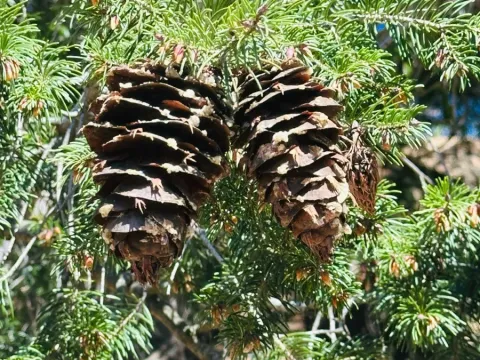
Bigcone Douglas fir
Pseudotsuga macrocarpa
The Bigcone Douglas fir (Pseudotsuga macrocarpa) is a member of the Pinaceae family, native to the mountains of Southern California. It is a slow-growing evergreen tree known for its significant size and longevity.
What the section contains
Bigcone Douglas fir
This species thrives in a Mediterranean climate characterized by mild, wet winters and warm, dry summers. It is remarkably drought-tolerant, making it a specialized choice for reforestation in arid mountain environments.
The ideal soil for this conifer is rocky, well-drained, and nutrient-rich. It does not tolerate waterlogged conditions, so selecting sites with proper topographical drainage is essential for healthy root development.
Bigcone Douglas fir is highly light-demanding throughout its lifecycle. In nursery and plantation settings, sufficient spacing is required to ensure that the lower branches receive enough sunlight for long-term health.
The tree exhibits a deep root system that anchors it securely in steep, rocky terrain. This biological feature allows it to survive in locations where other tree species struggle to establish themselves due to unstable ground.
The primary threats to Pseudotsuga macrocarpa are fungal diseases, particularly those that impact the needles and vascular system during excessively humid or rainy growing seasons.
Bark beetles and wood-boring insects are the most destructive pests. These organisms often attack trees already stressed by drought, wildfire damage, or poor site conditions, causing severe decline.
Wildfire represents a significant risk to the populations of this species. While mature trees possess a thick bark that offers some insulation, intense fires can cause irreparable damage to the cambium layer.
Defoliating insects can occasionally lead to significant growth suppression. Integrated pest management strategies should be employed to monitor population levels of these insects to prevent large-scale outbreaks.
Proper silvicultural practices, including thinning and debris management, are vital to mitigate the risks of both pest colonization and fire, ensuring the long-term sustainability of the stand.