
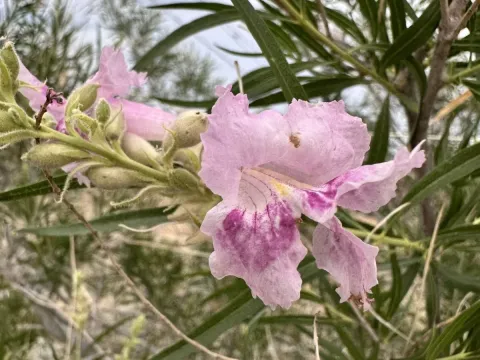
Desert willow
Chilopsis linearis (Cav.) Sweet
Chilopsis linearis, commonly known as desert willow, is a deciduous tree or shrub belonging to the Bignoniaceae family. Despite its common name, it is not related to the true willow genus but earned the name due to its willow-like foliage.
What the section contains
Desert willow
Native to the southwestern United States and Mexico, this species is naturally adapted to arid environments. It typically grows in desert washes, canyons, and areas where subterranean water is accessible.
This crop requires full sun exposure to flourish and produce its characteristic orchid-like flowers. It is highly intolerant of heavy, waterlogged soils and performs best in well-drained, sandy, or rocky soil types.
Agronomic management of Chilopsis linearis is relatively straightforward once the plant is established. It exhibits remarkable drought tolerance, making it an excellent candidate for xeriscaping and water-wise gardening.
The plant is highly valued for ornamental purposes in urban landscapes due to its long blooming season. Additionally, its extensive root system makes it an effective species for soil stabilization in arid regions.
Desert willow is generally resistant to most diseases. However, the most significant threat is root rot, which occurs primarily when the plant is grown in poorly draining soils or subjected to excessive irrigation.
Pest problems are usually minor but can include infestations of aphids or spider mites. These issues are most frequent in nursery settings where humidity levels are higher than in the plant's natural habitat.
Occasional defoliation caused by caterpillars may occur, but these events rarely impact the overall vigor of mature, well-established specimens in a natural landscape setting.
Good horticultural practices, such as proper spacing and avoiding overhead irrigation, are essential to minimize the risks posed by humidity-related fungi and foliage-eating insects.
Maintaining a regular pruning schedule helps improve air circulation within the canopy, which effectively reduces the likelihood of both fungal pathogens and pest colonization.