
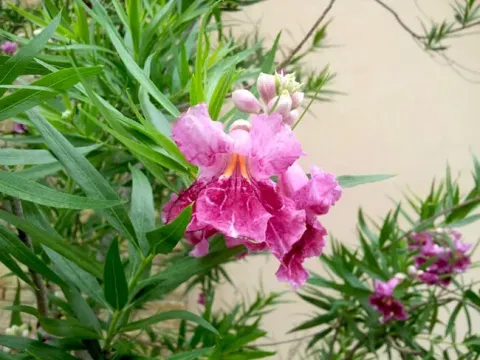
Chilopsis
Chilopsis D. Don
Propagation of Chilopsis can be achieved through seeds, which should be sown in the spring after all danger of frost has passed. The soil temperature must be warm to ensure optimal germination rates for the seeds.
What the section contains

Chilopsis
It is advisable to soak the seeds in warm water for 24 hours before planting to enhance the germination process. This practice helps to soften the seed coat and prepare the embryo for rapid emergence in the soil.
Seeds are sown at a shallow depth of about one centimeter in well-draining potting soil. Maintaining constant humidity without waterlogging is crucial during the initial stages of seedling development.
Seedlings should be kept in a bright, warm environment until they are robust enough to be transplanted. Acclimatization to outdoor conditions should be done gradually over a period of two weeks.
For vegetative propagation, softwood cuttings taken in late spring provide high success rates. Using a rooting hormone and a mist system ensures the cuttings develop a strong root system before winter.
Chilopsis, commonly known as desert willow, is a member of the Bignoniaceae family. It is a deciduous shrub or small tree native to the southwestern United States and Mexico, thriving in arid environments.
This plant requires full sun exposure to produce its characteristic trumpet-shaped flowers. It is highly adaptable to various soil types but insists on excellent drainage to prevent root diseases.
Watering should be deep but infrequent once the plant is established. This encourages the root system to penetrate deeper into the soil, reinforcing the plant's natural resistance to summer droughts.
The plant is sensitive to frost and extreme cold. In temperate climates, it is often grown in containers that can be moved indoors during the winter months to protect the structural integrity of the plant.
Pruning is an essential maintenance task that should be performed in early spring. Removing spent flowers and thinning the interior branches helps maintain a clean shape and improves air circulation throughout the canopy.
The most common disease affecting Chilopsis is powdery mildew, which appears as a white, powdery fungus on leaves. This typically occurs in high-humidity areas with poor air circulation.
Root rot is the most serious threat, usually caused by overwatering or planting in heavy, clay-based soils that do not allow for rapid water drainage. Prevention is key, as treatment for advanced rot is difficult.
Insect pests such as aphids and spider mites can attack the new foliage during the growing season. These pests feed on the sap and can significantly weaken the plant if left untreated.
Integrated Pest Management (IPM) strategies, including the use of beneficial insects and neem oil, are recommended for control. Regular monitoring of the underside of leaves is necessary for early detection.
Finally, scale insects may occasionally infest the stems. If detected, they can be manually removed or treated with horticultural oils during the dormant season to ensure the long-term health of the shrub.