
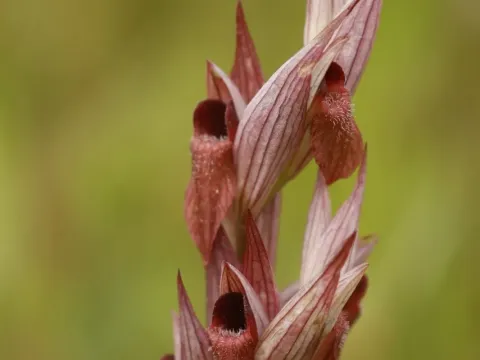
Serapias
Serapias
Serapias is a genus of perennial herbaceous plants belonging to the Orchidaceae family. In their natural habitat, these plants develop from subterranean tubers, which function as storage organs for nutrients, ensuring survival during periods of drought.
What the section contains
 Eastern Serapias
Serapias orientalis
Eastern Serapias
Serapias orientalis
 Serapias cordigera
Serapias cordigera
Serapias cordigera
 Serapias neglecta
Serapias neglecta
Serapias neglecta
 Serapias nurrica
Serapias nurrica
Serapias nurrica
 Serapias olbia
Serapias olbia
Serapias olbia
 Serapias perez-chiscanoi
Serapias perez-chiscanoi
Serapias perez-chiscanoi
 Serapias vomeracea
Serapias vomeracea
Serapias vomeracea
 Small-flowered tongue-orchid
Serapias parviflora
Small-flowered tongue-orchid
Serapias parviflora
 Tongue orchid
Serapias lingua
Tongue orchid
Serapias lingua
Serapias
The distribution range of the culture mainly covers the countries of the Mediterranean basin. These plants prefer open sunny sites, meadows, pastures, and sparse woodlands, where the level of insolation is sufficient for successful photosynthesis.
Soil requirements for Serapias include a well-drained substrate structure. The plants develop best in soils with a neutral or slightly acidic reaction, avoiding stagnant water, which is fatal to the root system and tubers.
The climatic preferences of the culture are associated with a mild Mediterranean climate. They are capable of withstanding short-term temperature drops; however, in severe winter conditions, they require reliable protection or cultivation in controlled greenhouse environments.
The agricultural use of Serapias is limited mainly to decorative purposes in specialized horticulture. Although the plant is not a mass agricultural crop, its exotic appearance and unique inflorescence morphology attract the attention of breeders and landscape designers.
The main threats to the genus Serapias are fungal diseases of the root system that occur when agricultural practices are violated and the soil is overwatered. Excess moisture triggers tuber rot, which often leads to the complete loss of the plant.
Pests, such as aphids and spider mites, can attack the aerial part of the plant during active growing periods. To control pest populations, it is recommended to use systemic insecticides and maintain an optimal level of air humidity.
Competition with weeds is a critical factor during the early stages of growth. It is necessary to ensure that planting sites remain free from aggressive grasses that might shade the light-loving Serapias.
Soil compaction and restricted air circulation in the root zone are also classified as serious threats to the development of the crop. Regular loosening of the topsoil layer helps prevent oxygen deprivation of the roots.
Viral infections transmitted through pruning tools pose a hidden threat. It is essential to disinfect gardening equipment after every contact with the plant to prevent the spread of pathogens throughout the collection.