
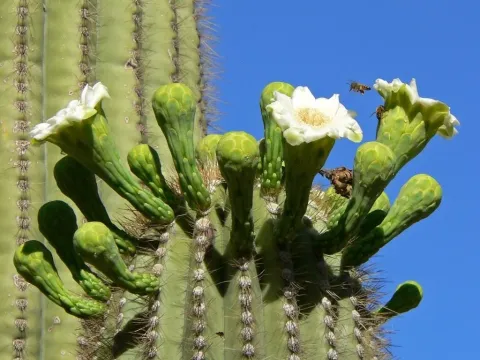
Carnegiea
Carnegiea Britton & Rose
The propagation of the Saguaro cactus (Carnegiea gigantea) from seeds is a slow and demanding process that requires strict environmental control.
What the section contains

Carnegiea
Sowing in a controlled environment is best performed in early spring, as the lengthening daylight hours provide the necessary stimulus for the young seedlings.
Successful germination requires soil temperatures maintained between 25 and 30 degrees Celsius, alongside high atmospheric humidity during the initial growth phase.
The growing medium must be highly porous and well-draining, consisting primarily of coarse sand or perlite to prevent moisture stagnation and fungal attacks.
Carnegiea is notorious for its extremely slow growth rate, requiring growers to exercise patience until the seedlings are robust enough for individual repotting.
As a iconic succulent of the Cactaceae family, Carnegiea is perfectly adapted to the harsh conditions of the Sonoran Desert and similar arid environments.
The plant demands maximum solar exposure; even minimal shading can cause etiolation and structural weakness in the columnar stem.
A well-draining, rocky soil composition is the most critical requirement, as any waterlogged soil will inevitably lead to root system decay.
While mature plants can withstand some temperature fluctuations, they are sensitive to prolonged frost, necessitating indoor protection in non-native climates.
Their unique anatomy allows them to function as massive water reservoirs, enabling the plant to survive extended periods of extreme drought.
Carnegiea is not an agricultural crop in the conventional sense, as its biological timeline does not align with commercial harvesting cycles.
Historically, the fruits produced by the Saguaro have served as a significant food source for indigenous populations, prized for their sweet flavor and nutritional content.
Harvesting the fruit requires specialized long-reach poles, as the plant is protected by formidable spines that guard its thick, succulent flesh.
While the seeds can be processed into oils or flour, the plant is primarily valued for its ecological role and its status as a cornerstone of desert biodiversity.
In modern horticultural applications, the yield is measured in terms of botanical significance and its role in landscaping and conservatory collections.
Fungal pathogens and root rot, often triggered by overwatering or poor air circulation, are the primary causes of mortality in cultivated Carnegiea.
Young seedlings are particularly vulnerable to pests such as mealybugs and spider mites, which can rapidly desiccate the fragile tissue of the epidermis.
In wild populations, avian and rodent activity can damage the stem, creating open wounds that are highly susceptible to secondary bacterial infections.
Climate instability and the decline of specific pollinator species pose long-term threats to the natural reproductive capacity of the species.
Excessive humidity in poorly ventilated glasshouses often leads to corky spot or surface discoloration, significantly detracting from the plant's health and appearance.
The traditional harvest involves using long wooden poles to detach the fruits from the upper branches without exerting damaging pressure on the cactus itself.
Timing is critical, as the fruits ripen quickly during the peak of summer heat and will dehydrate or rot if not collected immediately upon maturity.
Post-harvest processing involves immediate extraction of seeds and flesh to ensure the quality of the harvested materials remains stable.
The nature of the plant prohibits any form of automated or mechanical harvesting, necessitating a labor-intensive and manual approach at every stage.
The long-term health of the plant depends on the care taken during harvest, as structural damage to a mature Carnegiea is often permanent and irreparable.