
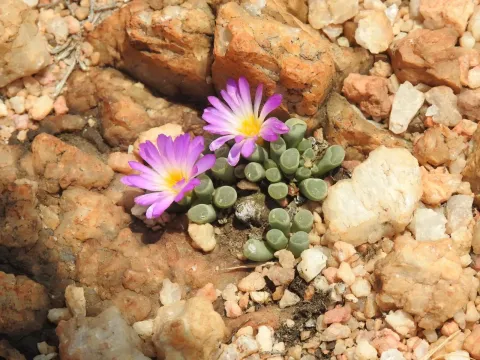
Frithia
Frithia
Sowing Frithia seeds is best achieved in late winter to early spring, providing enough light for the seedlings to thrive throughout their development phase.
What the section contains


Frithia
Seeds should be sown on a fine-textured, well-draining substrate mix of sand and peat. Do not cover the seeds with soil, as they require light to break dormancy and trigger germination.
The pots must be covered to maintain high humidity levels during the germination process. Daily ventilation is mandatory to prevent fungal issues caused by stagnant air.
Seedlings emerge within two to four weeks. Transitioning them from a humid environment to a drier climate must be done gradually over several weeks to avoid shock.
Given their slow growth rate, the young plants should not be disturbed for several months. Wait until the plants are large enough to handle before attempting any repotting.
Frithia is a genus in the Aizoaceae family, native to arid regions of South Africa. It is a highly specialized succulent adapted to survive in extreme, light-abundant environments.
The plant demands high light intensity. It requires as much direct sunlight as possible to maintain its compact growth form and to support the production of its characteristic daisy-like flowers.
The potting medium must be extremely well-draining, consisting primarily of mineral components such as grit, perlite, and coarse sand. Organic content should be kept to a bare minimum.
Watering should be strictly regulated according to the plant's cycle. During the growing season, water only after the soil has completely dried out; during winter, keep the plant almost entirely dry.
Temperature management is key: while it thrives in warm temperatures during the summer, a cooler resting period of 10–12°C during winter is essential to ensure the plant's long-term health.
The primary threat to Frithia is moisture stress caused by overwatering. Excess water leads to rapid root rot, which often becomes irreversible before visible symptoms appear above ground.
Pests like mealybugs can nestle between the succulent leaves, causing damage that stunts the plant's growth and leaves it vulnerable to secondary infections.
Spider mites are also a common issue, thriving in dry, hot environments where ventilation is inadequate, leading to discolored and scarred leaf surfaces.
Fungal pathogens represent a major risk, especially when the plant is kept in humid conditions with poor light, leading to the collapse of the leaf tissues.
- Always use pots with efficient drainage holes.
- Check plants frequently for signs of mite infestation.
- Ensure excellent airflow in the growing area.
- Avoid watering during the dormant period.