
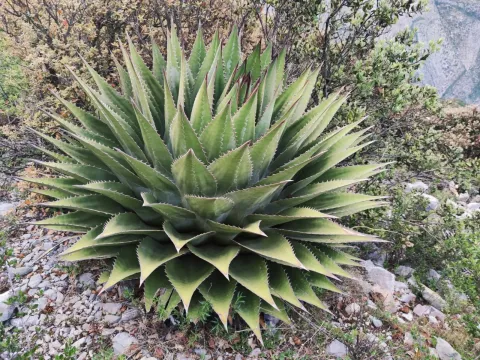
Mountain agave
Agave montana
Mountain agave (Agave montana) is a striking succulent belonging to the Asparagaceae family. Native to the high-altitude regions of the Sierra Madre Oriental in Mexico, this species has evolved to tolerate cooler temperatures and harsher conditions than most other agave species.
What the section contains
Mountain agave
The plant thrives in full sun and requires well-drained, gritty, or sandy soil. It is particularly sensitive to excessive moisture, especially during the winter months, making efficient drainage an essential factor for preventing root rot and ensuring long-term health.
Climate requirements for Agave montana include a preference for cool mountain air and moderate rainfall. It is remarkably cold-hardy, surviving light frosts, provided the soil remains dry. In wetter climates, it requires protection from excessive moisture during the winter season.
Botanically, the mountain agave is characterized by a dense, symmetrical rosette of broad, glaucous-green leaves with sharp marginal teeth. It grows slowly, forming a substantial architectural structure that can reach an impressive size over several years of cultivation.
In terms of agricultural and horticultural use, it is prized as a premium ornamental plant. Its drought tolerance and low maintenance requirements make it a staple in xeriscaping and sustainable garden designs across temperate regions with mild winters.
The primary threat to the health of the mountain agave is fungal decay caused by waterlogged soil. Inadequate drainage or high ambient humidity can lead to rapid decomposition of the roots and the core, which is often fatal for the succulent.
Insect pests, such as mealybugs, are common threats. These insects feed on the plant's sap, residing in the crevices between leaves. Persistent infestations can severely weaken the plant and facilitate the development of secondary bacterial infections.
The agave snout weevil represents a significant danger, as larvae burrow into the heart of the plant. This damage is often irreversible, leading to the collapse of the rosette. Monitoring for signs of boring or decaying tissue is critical for survival.
Preventative care involves regular inspections and the application of systemic insecticides when necessary. Keeping the base of the plant free of debris and ensuring good airflow around the rosette can significantly reduce the risk of pest colonization.
Overall, successful cultivation is achieved by mimicking its native dry-slope habitat. By managing irrigation precisely and prioritizing soil aeration, gardeners can effectively mitigate the majority of risks and diseases associated with this robust species.