

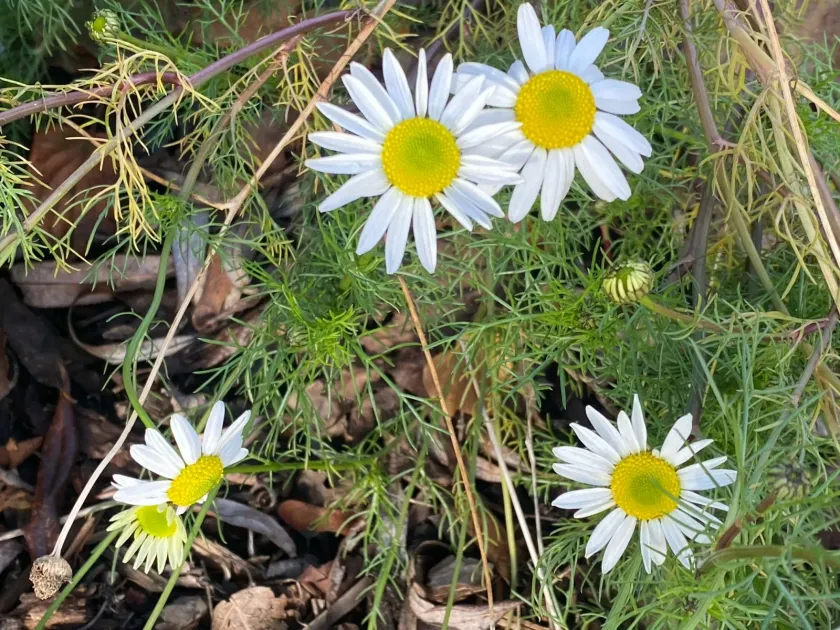
Description
How to tell it apart
Scentless mayweed, known scientifically as Tripleurospermum inodorum, is an annual or biennial herbaceous weed belonging to the Asteraceae family.
It closely resembles common chamomile but lacks the characteristic fragrance. The stem is branched, growing up to 80 cm tall, with finely dissected leaves.
The inflorescences are solitary flower heads with white ray florets and yellow disk florets, giving it a classic daisy-like appearance in the field.
A key diagnostic feature is the receptacle, which is solid (filled with tissue) in scentless mayweed, whereas in true chamomile, it is hollow.
This species is highly prolific, producing thousands of small, light seeds that are easily dispersed by wind, water, and agricultural machinery.
Where it grows
Scentless mayweed is a widespread agricultural weed that thrives in disturbed soils, cultivated fields, roadsides, and wasteland across temperate regions.
It prefers fertile, moist soils and is particularly aggressive in spring-sown cereal crops, oilseed rape, and various vegetable crops.
The plant is highly adaptable and can grow in a wide range of soil pH levels, making it a persistent problem in diverse farming systems.
It is capable of germinating both in autumn and spring, which allows it to successfully compete with winter crops and complicate weed management.
It often establishes dense colonies in areas with reduced tillage, quickly dominating the canopy of less competitive crop varieties.
Harm it causes
The primary economic harm is caused by intense competition for nitrogen, water, and sunlight, which significantly suppresses crop growth and reduces yield.
In cereal crops, the presence of mayweed complicates mechanical harvesting, increasing the moisture content of the grain and requiring additional cleaning.
The weed acts as an alternative host for various pests and pathogens, including viruses that can infect high-value crops like potatoes or carrots.
When present in high densities, it can overwhelm forage crops in meadows and pastures, reducing the overall nutritional quality of hay and silage.
The high seed bank longevity means that even after one season of poor control, the weed can plague the field for several subsequent years.
How to control
Effective control starts with good agronomic practices, such as deep plowing to bury seeds and prevent germination from the upper soil layers.
Crop rotation remains the cornerstone of management, rotating broad-leaved crops with competitive grasses to disrupt the life cycle of the weed.
Chemical control involves the timely application of selective herbicides, particularly targeting the rosette stage of the weed for maximum efficiency.
Mechanical cultivation between crop rows and the use of competitive seeding rates help to shade out the weed and limit its development.
- Utilize certified, weed-free seed to prevent initial field infestation.
- Implement timely herbicide applications using recommended dose rates.
- Maintain strict field hygiene on margins and non-crop areas to reduce seed spread.
Content graph
Connections · Scentless mayweed
Most often together:
Marketplace
Products · 640


Torero
Finkemü Schwebda, F.GmbH, GERMANY, MEMBER OF GROUP
Herbicides
1
0
·
1.1K
2 offers
20.37 €per 1 l
Buy


Terramidin
Nanjing No.1 Pesticide Factory of Red Sun Group Co., Ltd.
Herbicides
0
0
·
1.1K
1 offer
7.61 €per 1 l
Buy


Controller
Ф.Меатон Лімітед, Лондон, Великобританія.
Herbicides
0
0
·
749
2 offers
40.19 €per pack
Buy


ALPHA-STAR V.G.
Ф.Меатон Лімітед, Лондон, Великобританія.
Herbicides
0
0
·
163
4 offers
30.48 €per 1 l
Buy


NOPASARAN K.S.
ф.БАСФ СЕ, Німечина на заводі м.Гравелін
Herbicides
0
0
·
101
2 offers
26.38 €per 1 l
Buy


Caméo 75, w.g., (Tribenuron-methyl, 750 g/kg)
DuPont de Nemours
Herbicides
0
0
·
90
3 offers
15.44 €per 1 l
Buy


DICBAN, RK
Ф.Суперус Ко ., Лтд., Гонг-Конг, Шанхай, Китай.
Herbicides
0
0
·
78
2 offers
11.24 €per 1 l
Buy


Dissulam, SE
Jiangsu Institute of Ecomones Co., Ltd.
Herbicides
0
0
·
74
24 offers
0.93 €per 1 l
Buy


Magnum v.d.g.
ЗАТ Фірма Август, Росія.,селище Вурнари,
Herbicides
0
0
·
69
2 offers
109.25 €per 1 l
Buy


Triton
Три Дельта Компані Інтернешнл, Гонконг, Китай.
Herbicides
0
0
·
66
1 offer
6.75 €per pack
Buy


Alpha-Maïs, WG, herbicide + PAR «Alfalip»
Alpha Smart Agro
Herbicides
0
0
·
65
15 offers
2.99 €per 1 l
Buy


Biology
Taxonomy
- Latin name
- Tripleurospermum inodorum
- Family
- Однолетние двудольные сорняки