

Description
How to tell it apart
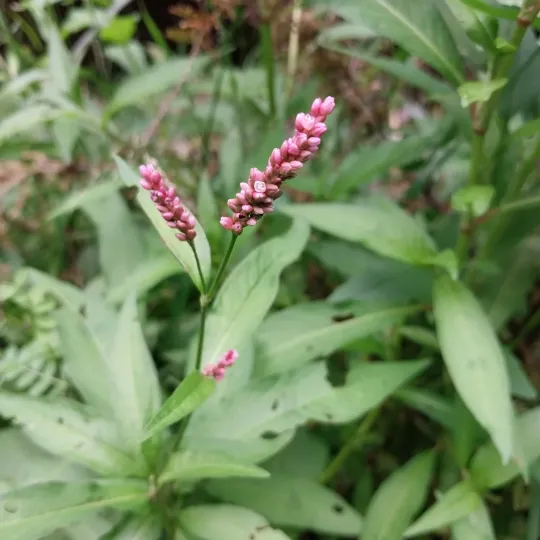
Redshank (Persicaria maculosa), also known as lady's thumb, is a common annual weed in the Polygonaceae family. It typically reaches a height of up to 80 cm, featuring branched stems characterized by reddish nodes.
The leaves are lanceolate in shape and often display a distinct dark, thumb-print-like spot in the center, which is the most reliable diagnostic feature. The stems and leaves may be glabrous or covered with fine, pressed hairs.
The plant produces dense, cylindrical flower spikes, usually pink or occasionally white, at the tips of the stems. Flowering occurs throughout the summer, resulting in a high seed production capacity that facilitates rapid spread.
It possesses a strong taproot system, enabling the weed to thrive in various soil types and compete effectively for moisture. Seedlings are easily identified by their reddish hypocotyl and elongated cotyledons.
Redshank is a prolific seed producer, with a single plant potentially generating thousands of seeds. These seeds are long-lived in the soil, often remaining viable for several years and germinating from depths of up to 10 cm.
Where it grows
Redshank is widely distributed in temperate regions, favoring moist and nutrient-rich soils. It frequently colonizes areas near bodies of water, drainage ditches, and roadsides, spreading from these reservoirs into agricultural fields.
This weed is particularly troublesome in row crops, including maize, sugar beet, soybeans, and sunflowers. It also poses a significant threat to cereal crops, especially in low-lying or poorly drained fields.
Due to its ecological adaptability, Redshank readily colonizes fallow fields, gardens, and freshly cultivated land. It serves as an indicator species for nitrogen-rich soils that may experience periodic waterlogging.
The weed is easily dispersed across farming operations via contaminated irrigation water, farm machinery, and poor-quality seeds. Its presence in fields often correlates with localized areas of soil compaction or drainage issues.
Effective management requires addressing these habitat preferences, as Redshank's ability to exploit moist conditions allows it to outcompete crops during the early stages of development.
Harm it causes
The primary damage caused by Redshank is its rapid biomass accumulation, which leads to significant shading of crop seedlings. This competition for light suppresses early crop growth and reduces stand density.
Redshank is a heavy consumer of nitrogen and water. By sequestering these essential resources, it limits the growth potential of the primary crop, resulting in substantial yield losses, especially under drought conditions.
The presence of dense Redshank infestations complicates routine agricultural tasks, such as inter-row cultivation and the application of chemical plant protection products, reducing the overall efficiency of farm operations.
It also functions as an alternative host for various crop pathogens and pests. Several viral diseases and fungal infections can persist on Redshank leaves before spreading to economically important vegetable or grain crops.
During harvest, Redshank seeds contaminate grain yields, necessitating costly cleaning and drying processes. This reduction in grain purity often lowers the commodity's market value and classification.
How to control
Cultural control measures focus on effective tillage practices. Deep plowing with soil inversion buries seeds at depths that prevent successful emergence, significantly reducing the initial weed population in the field.
Crop rotation and consistent field maintenance are crucial components of an integrated management plan. Regular inter-row cultivation in row crops effectively eliminates emerging seedlings before they establish deep roots.
Chemical control should be implemented during the early growth stages (from cotyledon to two true leaves). Systemic herbicides are most effective when applied before the plant develops its full, hardy foliage.
In cereal and maize crops, selective herbicides from the sulfonylurea or phenoxy-acid groups provide effective control. Strict adherence to application rates and timing is necessary to prevent crop injury while ensuring weed mortality.
Proactive monitoring is essential to keep weed pressure below economic threshold levels. By managing Redshank early, farmers can prevent the long-term buildup of the soil seed bank and ensure optimal crop productivity.
Content graph
Connections · Redshank
Most often together:
Marketplace
Products · 79


Galera 334 SL
Доу АгроСайенсіс С.А.С., Друзенхайм, Франція
Herbicides
0
0
·
2.6K
3 offers
71.48 €per pack
Buy


Galeon
«Нанджин Ессенс Файн-Кемікал Ко. Лтд» (Китай)
Herbicides
0
4
·
1.3K
3 offers
4.78 €per 1 l
Buy

Gyurza
Джангсу Ротам Агрокемікал Ко., Лтд., Шанхай Китай
Herbicides
0
0
·
1.2K
5 offers
5.9 €per 1 l
Buy


Neolith
Ф.Суперус Ко ., Лтд., Гонг-Конг, Шанхай, Китай.
Herbicides
0
0
·
977
2 offers
34.4 €per 1 l
Buy


GELION V.R.
Джінан Кесайджінонг Хім. Ко. Лтд., Джінанг, Китай
Herbicides
0
0
·
66
1 offer
11.6 €per 1 l
Buy


ASTERA, w.p.
«Нанджин Ессенс Файн-Кемікал Ко. Лтд» (Китай)
Herbicides
0
0
·
64
4 offers
38.53 €per 1 l
Buy


Granstar Pro 75
«Дюпон Інтернешнл Оперейшнз Сарл», Швейцарія
Herbicides
0
0
·
61
4 offers
295.89 €per 1000 pcs
Buy


TRU, WG, (Tribenuron-methyl, 750 g/kg)
Sharda Worldwide Exports Pvt Ltd, Sharda World
Herbicides
0
0
·
54
5 offers
69.34 €per 1 l
Buy


SAMSON Extra 6 OD
«Аріста ЛайфСайенс С.А.С.» , Франція
Herbicides
0
0
·
49
2 offers
23.15 €per 1 l
Buy

Emerald W.R.K., (Imazethapyr 100 g/l)
Sharda Worldwide Exports Pvt Ltd, Sharda World
Herbicides
0
0
·
47
2 offers
9.01 €per 1 l
Buy


Herbicide "Gold Star", granular, (tribenuron-methyl 750 g/kg)
«Нанджин Ессенс Файн-Кемікал Ко. Лтд» (Китай)
Herbicides
0
0
·
39
2 offers
27.08 €per 1 l
Buy


2,4-D-star
ТОВ «Фабрика агрохімікатів», Черкаси, Україна
Herbicides
0
0
·
35
1 offer
7.33 €per 1 l
Buy

Agriter Super 500 RK
Фадер Альянс Лтд., Великобританія (Fader Alliance Ltd., England) на заводах Нідерландів, Польщі
Herbicides
0
0
·
33
1 offer
1.17 €per 1 l
Buy

Lontgrand
«Нанджин Ессенс Файн-Кемікал Ко. Лтд» (Китай)
Herbicides
0
0
·
33
1 offer
205.83 €per 1 l
Buy


Fabian, WG
ЗАТ Фірма Август, Росія.,селище Вурнари,
Herbicides
0
0
·
31
4 offers
133.83 €per 1 l
Buy


Gerositol w.r.g., (tribenuron-methyl, 750 g/kg)
Sunrise Agrochemical Co., Ltd.
Herbicides
0
0
·
29
3 offers
22.19 €per 1 l
Buy

ALPHA-DICAMBA, EC
«Юнісіті Ентерпрайсіс Л.П.», Единбург, Великобританія
Herbicides
0
0
·
28
2 offers
10.34 €per 1 l
Buy

Webb, VG (tribenuron-methyl, 750 g/kg)
Nanjing Red Sun
Herbicides
0
0
·
26
4 offers
15.44 €per 1 l
Buy


Biology
Taxonomy
- Latin name
- Persicaria maculosa
- Family
- Однолетние двудольные сорняки