

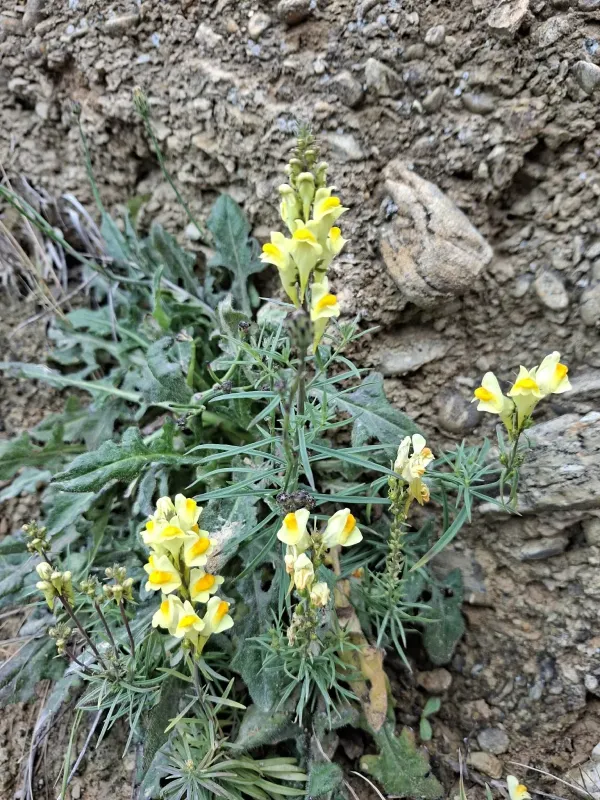
Description
How to tell it apart
Common toadflax (Linaria vulgaris) is a perennial herbaceous plant belonging to the Plantaginaceae family, characterized by its vigorous root system and yellow snapdragon-like flowers.
The plant features upright stems, ranging from 30 to 90 cm in height, densely covered with narrow, linear, glaucous leaves that give it a slightly bluish-green appearance.
Its root system consists of a deep taproot and extensive horizontal rhizomes that contain buds, allowing the plant to propagate vegetatively and form large, dense patches.
The inflorescence is a dense terminal raceme of bright yellow flowers, each featuring an orange patch on the lower lip and a distinct nectar-producing spur.
The fruit is a small, oblong capsule that produces thousands of flat, winged seeds, which are highly efficient at dispersal by wind across agricultural fields.
Where it grows
Common toadflax thrives in a variety of environments, including fields, meadows, roadsides, and disturbed areas, preferring light, sandy, or well-drained soils.
In agricultural systems, it acts as a troublesome weed in cereal crops, fallow land, and perennial pastures, where it often goes unnoticed until established.
The plant is highly drought-tolerant and can colonize nutrient-poor soils, making it a persistent competitor against desirable crop species.
It prefers sunny locations and quickly invades fields where mechanical soil disturbance is shallow or infrequent, providing space for rhizome segments to regenerate.
Its presence in field margins often serves as a reservoir for infestation into main crop areas if effective boundary management is ignored.
Harm it causes
The primary harm caused by common toadflax is its aggressive resource competition, as its deep root system depletes soil moisture and nutrients before crops can access them.
By forming thick, localized mats, the weed physically crowds out crop seedlings, significantly reducing stand density and overall crop vigor.
Yield losses occur due to suppressed growth and the reduction of photosynthetic capacity in crops overwhelmed by the weed's rapid development.
The presence of common toadflax can complicate harvest operations by increasing moisture content in the harvested grain and interfering with combine efficiency.
Furthermore, as a host for various insects and plant pathogens, common toadflax increases the overall pest pressure within an agricultural field.
How to control
Effective management of common toadflax requires a combination of intensive mechanical cultivation and targeted chemical control methods.
Deep plowing combined with timely harrowing is essential to starve the root system by repeatedly cutting off top growth during the growing season.
In agricultural fields, the application of systemic post-emergence herbicides is recommended to reach and kill the underground rhizome structure.
Chemicals such as 2,4-D, dicamba, or specific sulfonylureas are effective when applied during the vegetative stage, before the plant allocates resources to seed production.
Long-term control is best achieved through crop rotation, incorporating competitive crops that shade out toadflax and exhaust its root reserves over several seasons.
Reference
Connections · Common toadflax
Most often together:
Marketplace
Products · 3
Biology
Taxonomy
- Latin name
- Linaria vulgaris
- Family
- Подорожник большой
- EPPO code
- LINVU