
Scoparia dulcis
Scoparia dulcis
Description
How to tell it apart
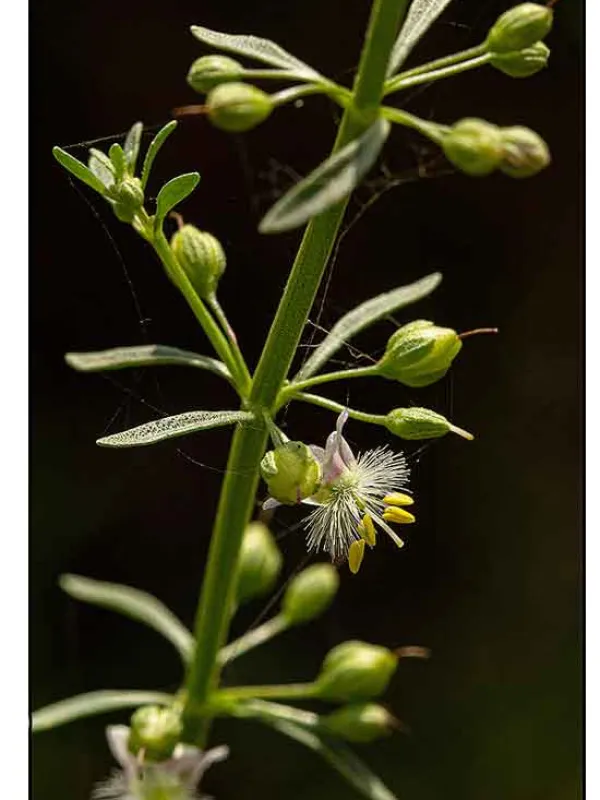
Scoparia dulcis, commonly known as sweet broomweed, belongs to the Plantaginaceae family. It is an herbaceous plant that grows as an annual or perennial shrub, typically reaching heights of 30 to 100 cm.
The stems are branched and woody at the base. The leaves are simple, arranged in opposite or whorled patterns, and possess serrated margins, which is a key identification feature.
Its flowers are small and white, occurring singly or in pairs in the leaf axils. They have four petals and conspicuous stamens that are characteristic of the species.
The fruit is a small, globose capsule that splits open upon maturity to release numerous tiny, brown seeds, ensuring efficient wind and water-mediated dispersal.
The plant possesses a robust taproot system that enables it to withstand dry spells and compete aggressively with crops for water and nutrient resources.
Where it grows
Scoparia dulcis is widely distributed across tropical and subtropical regions. It is highly adaptable and thrives in disturbed habitats, roadsides, and open grasslands.
In agriculture, it is considered a significant weed in plantations of rice, soybeans, maize, and sugarcane, where it can quickly become the dominant plant species.
The weed prefers well-lit environments but shows significant tolerance to various soil types, ranging from sandy soils to heavier clay soils if moisture is sufficient.
It colonizes agricultural fields rapidly following soil disturbance, such as tillage, as these conditions are optimal for the germination of its prolific seed bank.
Human activity is a primary driver of its spread, as seeds are easily transported via contaminated machinery, farming equipment, and human foot traffic.
Harm it causes
The primary damage caused by Scoparia dulcis is the significant reduction in crop yields due to direct competition for essential nutrients, light, and soil moisture.
Its fast growth rate allows it to outcompete emerging crop seedlings, leading to reduced plant density and uneven growth in fields, which compromises harvest quality.
Beyond competition, the weed serves as a host for various plant pathogens and insect pests, increasing the risk of diseases spreading to the primary crops.
In pastures, its presence decreases the quality of forage, as it is often unpalatable to livestock, leading to a reduction in available grazing biomass.
The sheer volume of seed production makes it difficult to manage once it is established, as the soil seed bank remains viable for multiple seasons.
How to control
Mechanical control, such as deep plowing and regular inter-row cultivation, is effective for managing Scoparia dulcis before it reaches the reproductive stage.
Crop rotation practices should be utilized to interrupt the lifecycle of the weed, ensuring that the field is not continuously dominated by conditions favoring its growth.
Chemical control involves the application of post-emergence herbicides. Choosing products that target broad-leaved weeds during the early vegetative phase is recommended.
Sanitation is crucial; cleaning farming equipment thoroughly before moving between fields is essential to prevent the spread of seeds into non-infested areas.
- Regular mowing of field margins to prevent seed dispersal.
- Application of selective pre-emergence herbicides in sensitive crops.
- Manual uprooting of plants before they form fruit capsules.
Taxonomy
- Latin name
- Scoparia dulcis
- Family
- Подорожник большой
- EPPO code
- SCFDU